
Produced in Damascus and its Countryside for Hundreds of Years- Qamr al-Din Industry Has Been Syria’s Gift to the World
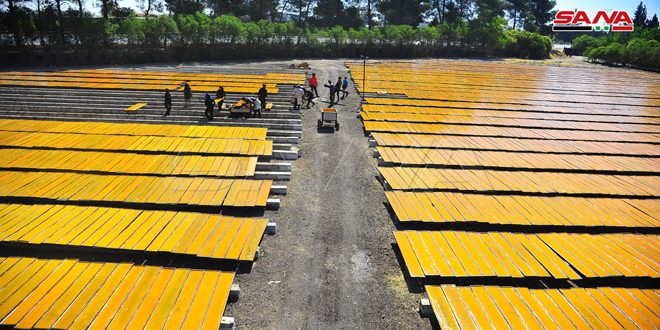
A visit to one of the orchards of Ghouta area, Damascus countryside, will give us an idea about the production of Qamar al-Din. It is a food industry that has belonged uniquely to Damascus and its countryside for hundreds of years.
When the Ghouta area is adorned with apricot fruit trees, factories rush to buy the largest amount of apricots for manufacturing Qamr al-Din; the ancient Sham (Levant) fruit industry that Syria has gifted to the world.
Owner of the facility and the apricot orchard, Mohammad Bashar Jaweesh, says, “Since the early morning hours, workers’ hands have embraced the apricot fruits for harvesting, which is the first stage in Qamr al-Din production.” He stresses that harvesting the fruits is a decisive stage in the production process because the harvest season lasts no more than forty-five days, bearing in mind that Qamr al-Din requires the best quality of apricots, called Klabi apricots, which contains a considerable amount of juice, and are perfect for making juice and jam.
With her round hat and a brightly colored shawl, Chief of labor, Fatima Um Mohammad, is waiting for the fruit boxes to arrive to feed them to the machines. She supervises the process of fruit sorting, washing the fruits in the special machines, drying them under pumped air, sterilizing them with sulfur blossom substance, and then putting them in a chrome-made juice extractor. There are two stages, the first of which is de-stoning the fruits, and the second is peeling them and removing the fibers to extract pure juice. The juice is then poured in a special vat and glucose is added until the produce has a soft texture and becomes more consistent, which is a very important process. According to Fatima, failure to add correct measurements of glucose will make the produce hard to touch and pale in color.
Working in nature, in an orchard that smells of apricots, is a special ritual, according to worker Asmaa, as the shy whispers and laughs of the workers mix with the machines’ roaring while smoothing out the produce through passing it through automatic fine sieves and pouring down into a special container. The next process is melting the produce in a burner.
Afterwards, the produce is transferred in carriages to wooden flat boards, called Mistahs, arranged over large areas of seven to eight dunums. A batch of two kilos is poured on each board and left to dry for 5 days and nights, until the produce reaches the familiar texture and appearance of Qamr al-Din. Then, the produce is plastic wrapped and stored in warehouses.
The work is permeated by a tea break, which is an essential part of the work process, during which the workers gather under a large umbrella, sipping their tea while looking at the artistic paintings, formed by the orange color of Qamr al-din, drying and turning into a paste on flat boards, under a blue sky that meets at the horizon with the vast green vegetation.
 Actually, the work day starts at 5 a.m. and ends when the produce is transferred to the warehouses to cool for several days, after it is wiped with oil as a final touch, the produce is then cut according to the customer’s request. Afterwards, the product trademark and production date are placed, thus it is ready for supply to the local market or for export.
Owner of the facility, Mohammed Bashar Jaweesh, points out that the seeds resulting from the manufacturing process are dried for 5 days, and delivered to nut crushers to separate shells from kernels. Kernels are then exported abroad on demand for producing oils, creams and some types of medicines. As for the fibers, they go for animal feed.
Jaweesh stresses that all the equipment, vats and utensils used in manufacturing are made of chromium which does not interact with foodstuffs nor corrodes with acid, adding that the glucose, mixed in Qamr al-Din, used to be produced locally, but now it is imported from abroad because the two factories that manufactured it are nonfunctioning any longer as a result of the war.
He goes on to note that the properties of Qmr al-din, saying that Qamr al-Din is a gut cooling agent and an intestinal laxative. It is also rich in potassium and vitamin A, as the latter is one of the unique natural components apricots are rich in. Qamr al- Din has a medicinal property that cures jaundice. It is worth mentioning that demand for Qamr al-din increases in Ramadan (the fasting month) which is traditionally particular of this month.
 Jaweesh points out that although some Syrians have produced Qamr al-Din abroad, their products couldn’t compete with the locally-made one, and this is due to the fact that the best type of apricots for making Qamr al-Din grows only in Ghouta, namely Klabi (canine) apricots, in addition to the special climate of Damascus countryside, along with the expert labor hand. He adds that Qamr al-Din which is produced abroad is dried artificially and not sun dried, which results in less quality of taste, color and nutrients.
Jaweesh remarks that adding glucose is relatively a new procedure to keep the bright color and special flavor to Qamr al-din, adding that the process of making Qamr al-Din has evolved through time, as it had earlier employed simple manual tools and equipment, such as manual mashing and pressing of the apricots. People had used simple sieves and firewood burners, so the overall production hadn’t exceeded 100 tons per season. Nowadays, there are several facilities that produce hundreds of tons using modern machines, but the sensitive drying process is still maintained since it sustains the unique quality of Qamr al-Din of the Levant (al-Sham(.
Rayan Faouri