
Prime Minister launches the National Strategy for Agricultural Development in Syria
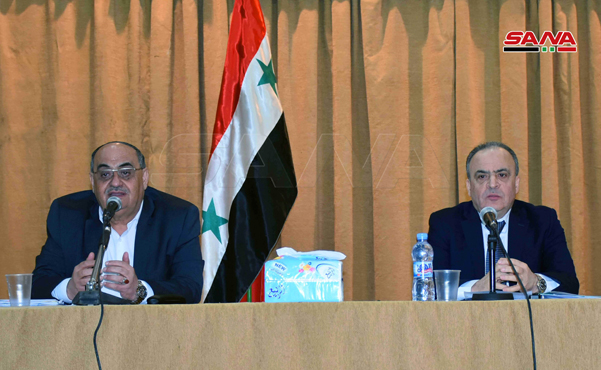
Within the framework of achieving “self-reliance” to support the national economy through active partnership with farmers and agricultural producers, Prime Minister Eng. Imad Khamis has launched the national Strategy for agricultural development in Syria with an initial cost of SYP 5 billion for the first year , starting in al-Ghab area in Hama..
The strategy depends on taking advantage of arable land in agricultural production of crops and livestock through the public and private sectors within specific agricultural programs. Focus should be given to household agriculture , rural women project, and household production of poultry and fish as their productive, social and developmental feasibility is no less important than the large productive facilities.
The national strategy also stressed the importance of supporting the strategic agricultural crops, which constitute Syria’s source of food security and national economy , along with securing production requirements for farmers and breaking the siege and coercive measures imposed on the Syrian people.
The national strategy included a plan to secure the needs of the agricultural sector, including fertilizers and insecticides , modern irrigation equipment , fuel and agricultural machinery, facilitating and granting of loans to farmers and producers and providing all facilities that support them in the continuity of their production.
Eng. Khamis underlined, during a meeting held at the General Commission for Management and Development of al-Ghab in Hama, that the agricultural sector will remain the main pillar of Syria’s national economy in confronting the terrorists war against Syria at various levels .
He called for taking into consideration the specificity of each Syrian province in implementing the agricultural plan , pointing out that there would be effective and influential agricultural teams to follow-up the implementation of agricultural strategies to achieve self-sufficiency in production.
The Minister of Agriculture and Agrarian Reform Eng. Ahmed Al-Qadiri reviewed the most prominent features of the national strategy for agricultural development in the Al-Ghab region, which is divided into two strategic and immediate stages to meet al-Ghab region’s needs in different domains.
Top priority should be given to rehabilitating the irrigation networks and revitalizing the livestock resources , in addition to establishing facilities for producing dairy and cheese products.
The Director General of the General Commission for Management and Development of al-Ghab Awfa Wassouf reviewed the human and natural resources of al-Ghab area and its economic position on the agricultural production map.
He indicated that the arable lands of al-Ghab region cover than 87,000 hectares, the most important crops of which are wheat, barley, sugar beets, and potatoes, referring to the damage of a number of dams, irrigation canals and other water facilities caused by the sabotage acts carried out by terrorists.
Rawaa Ghanam