
President of ICRC: The economic blockade on Syria has significant impact on society and economy
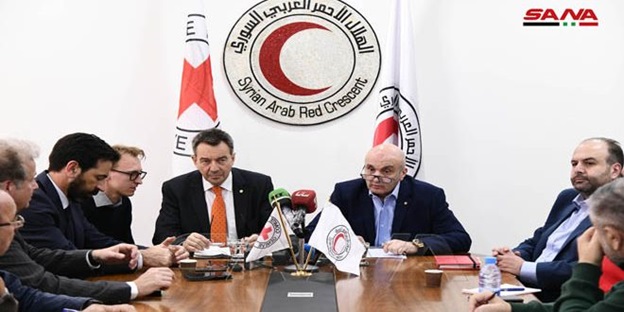
President of the International Committee of the Red Cross (ICRC) Peter Maurer stressed that the economic blockade on Syria has a great impact on society and economy, which is reflected in basic human needs.
In a press conference held on Tuesday with the President of the Syrian Arab Red Crescent (SARC) Khaled Hboubati, Maurer pointed out that the citizens wish to return to their homes in the liberated areas. The humanitarian needs of the people in Syria are increasing due to the war on them, this in turn necessitates the need to establish appropriate infrastructure.
“The current challenges are not only represented in providing appropriate humanitarian needs, but in politicizing the crisis in Syria, especially in Idlib, which creates a great challenge for humanitarian work”, Maurer said. “The International Committee of the Red Cross will attach great importance to Syria during the coming months and years to meet humanitarian needs”.
Maurer noted that his talks with Foreign Minister and Expatriates Walid al-Muallem and his Deputy, Dr. Faisal al-Miqdad, were important, adding: “We have expressed our commitment to do our utmost to provide humanitarian assistance to the people in need”.
Maurer stressed that the SARC is a key partner in carrying out the committee’s activities in Syria, appreciating the close cooperation over nine years in various fields.
Maurer pointed out that an agreement had been signed in the last two weeks in the fields of water, pollution and health.
In turn, Hboubatti confirmed that the organization is completing its role in supporting those affected by the 10-year crisis in Syria, with the participation of the ICRC which was considered a main partner in accessing the services to millions of people until the end of 2019
Hboubatti pointed out that the Syrian Arab Red Crescent volunteers in northern Syria are under pressure to impede their work by threatening their security and forcing them to withdraw from some areas, like what happened during the work of the rehabilitation of the Alouk water station in Hasaka. SARC was also forced to stop working in the joint kitchen funded by the ICRC in Idlib, which constitutes a violation of international humanitarian law that stipulates the neutralization of humanitarian workers from conflicts and hostilities.
Habbouti pointed out that the organization seeks to help the affected people who lost their livelihoods, those who lost their limbs, people who are returning to their areas and breadwinner who are women by financing projects that suit their experiences, as the number of beneficiaries of these projects reached more than 82,000 people.
According to Habbouti, the organization also paid great attention to the primary health care services it provided through its hospitals, medical complexes, mobile clinics, mobile medical teams and prosthetic and physical therapy centers.
The Syrian Arab Red Crescent operates through more than 12,000 volunteers and has lost 65 of its staff (martyred) during the years of the terrorist war on Syria.
Inas Abdulkareem