
Palmyra’s funeral scenes … evidence of an ancient Syrian civilization
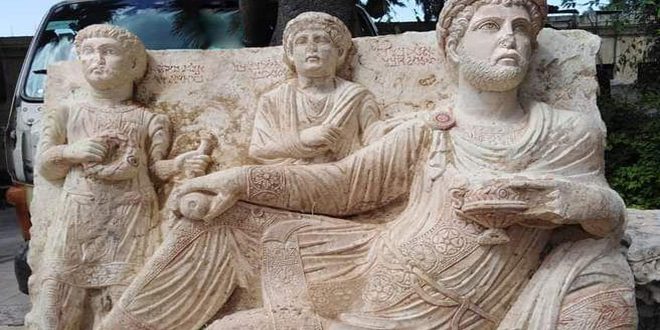
The monuments and funeral buildings of Palmyra were valuable scientific material for archaeologists, as they adopted a study and research that distinguished between those intended for the public class of the Tadmuri community and the huge funeral cemeteries of the rich class.
The Palmyrian funerary monuments are of great importance because not only because of their type of funerary monument, but also because it is one of the oldest remains of Palmyra, as most of them date back to the first century AD. Even the symbols and meanings of these monuments related to the world of death and its associated concepts, for this they were classified into several groups according to the inscriptions and images they carried.
The funerary tombstones known in al-Tadmuriyyah language as “Nafsh”, which means the person or the soul. i.e. it was a representation of the buried person, as it was planted inside a group of small stone pieces above the grave , where an inscription in al-Tadmuriyyah was engraved indicating the deceased, while we find other tombstones containing the funeral feast which represents the Palmyrian family with all its members.
In a statement to SANA, archaeologist Dr. Khalil al-Hariri explained that the rituals of burying the dead in Palmyra took into account the family life, as funeral scenes carved in stone and placed in front of the grave or above the funeral bed included images of a group of the dead’s family members.
As for the most important archaeological discoveries in Palmyra in this regard, they are as al- Hariri explained the funeral scene of a reclining Tadmuri man, who is Elabel Bin Tema, with two other people standing next to him. The first is his son Elabel and the second is his servant. He indicates that this information revealed by the Palmyrian writing inscribed on the shoulder of each of them.
Al-Hariri points out that the Elabel family was well- known in Palmyra and they had the Elabel Cemetery, which founded in 103 AD. The Palmyrene texts also mention that this family had a major role in building the Temple of Nebo, and this sculpture clearly indicates that this person was a prince or military commander.
Amal Farhat