
Octopus’s skin possesses the same cellular mechanism for detecting light as its eyes do
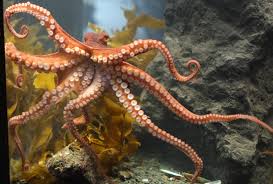
The octopus has a unique ability. It can change the color, pattern and even texture of its skin not only for purposes of camouflage but also as a means of communication. The most intelligent, most mobile and largest of all mollusks, these cephalopods use their almost humanlike eyes to send signals to pigmented organs in their skin called chromatophores, which expand and contract to alter their appearance.
A new study by scientists has found that the skin of the two-spot octopus (Octopus bimaculoides) can sense light even without input from the central nervous system. The animal does so by using the same family of light-sensitive proteins called opsins found in its eyes — a process not previously described for cephalopods.
“Octopus skin doesn’t sense light in the same amount of detail as the animal does when it uses its eyes and brain,” said lead author Desmond Ramirez,. “But it can sense an increase or change in light. Its skin is not detecting contrast and edge but rather brightness.”
In order to record the skin’s sensitivity across the spectrum, Ramirez exposed octopus skin to different wavelengths of light from violet to orange and found that chromatophore response time was quickest under blue light. Molecular experiments to determine which proteins were expressed in the skin followed. Ramirez found rhodopsin — usually produced in the eye — in the sensory neurons on the tissue’s surface.
According to Oakley, this new research suggests an evolutionary adaptation. “We’ve discovered new components of this really complex behavior of octopus camouflage,” said Oakley, who calls cephalopods the rock stars of the invertebrate world.
“It looks like the existing cellular mechanism for light detection in octopus eyes, which has been around for quite some time, has been co-opted for light sensing in the animal’s skin and used for LACE,” he explained. “So instead of completely inventing new things, LACE puts parts together in new ways and combinations.”
Octopuses are not the only marine mollusks whose skin can sense light, but scientists don’t know yet whether the skin of those other animals contains the light-sensitive opsins. If they do, Ramirez wants to understand how these two groups are related.”Do they all come from the same ancestral source or did they evolve multiple times?” he asked. “What kind of behaviors do the different groups share and what kind of behaviors does the skin sensing light underlie?”
Ramirez and Oakley are conducting new experiments that will seek to answer those questions and more.
Source: science daily
N.H.Kh