
National Cancer Detection Campaign launched in Homs under the slogan “Your awareness is your strength”
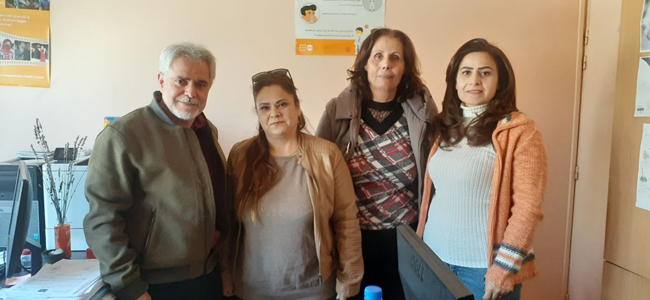
The city and countryside of Homs recently witnessed the launching of the national cancer control campaign, which is the first of its kind in Syria in terms of dealing with three of the most common kinds of cancers in Syria as in the world.
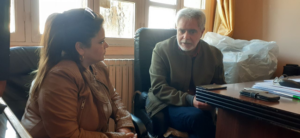
To learn more about the progress of the campaign, the Syria Times e-newspaper had a meeting with the Executive Supervisor of the campaign, Director of Reproductive Health in the Homs Health Directorate, Dr. Muhammad Al-Aboud, who said, “The national cancer control plan is the first work of the National cancer control Committee, which was formed in 2019. It consists of a set of strategic objectives, all of which constitute the Committee’s basic basis for achieving the goals of the Plan, recently named the National cancer control Program.
During the campaign, 3 types of cancer were selected to be investigated, namely; breast, cervical, and prostate cancer. The main determinant in this selection was the prevalence of these cancers, as the frequency of infections with these cancers that are recorded in tumor hospitals constitute the largest number, as well as they can be easily detected using citizen-acceptable investigative methods such as a mammogram, a prostate blood sample (PSA) or a cervical smear.”
“The idea I want to emphasize is that this campaign is not the same as previous campaigns for early detection of breast cancer. Rather, it is different in that it is a screening and not a detection campaign, as screening is one of the investigation tools. So, it is a wide-ranging investigation campaign that has more tools, larger centers, and its target diseases are 3 and not a single disease.
 It also requires the cooperation of several institutions, since one institution alone is unable to carry out such a large campaign. Therefore, this year’s campaign was held thanks to the concerted efforts of various concerned parties, including the Ministry of Health, the Ministry of Higher Education and Scientific Research, the Department of Military Medical Services of the Ministry of Defense, the Ministry of Local Administration, the Family Planning Association, civil society organizations, societies and donors.” Dr. Al-Aboud clarified.
With regard to the campaign processing mechanism, D. Al- Aboud explained, “We have been working with the partners to take the necessary measures to ensure that the campaign runs smoothly, and protocols have also been prepared to work on standardization so that we adopt a regular criterion for reading the results to reach the main objective of the campaign, namely the establishment of a national oncology register under which we will be able to know the frequency and geographical spread of the disease to serve as a basis for strategic planning at the government level to combat cancer, study risk factors in the areas of greatest prevalence of these cancers and to adopt ways of preventing them.
To achieve this goal, as planned, the campaign should cover all the countryside bearing in mind several factors, including: Geographical area and population density. We should also have a proper vision of how to provide the service. The ideal form was to run four mobile clinics equipped at a high level to detect the three cancers equipped and operated by the Military Medical Services Department.
The first and greatest challenge we have faced is that Homs occupies the largest geographical area in Syria and four vehicles are not enough to serve the vast area of the provincial countryside. This is what the Committee emphasized when it clarified that because of the limited possibilities resulting from the imposition of the unjust economic blockade on our country, the campaign will be completed in each governorate separately to eventually cover all governorates as scheduled.
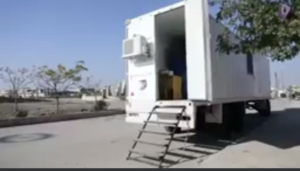 Another challenge is the advent of winter and the accompanying difficult weather conditions that do not encourage people to move out of their homes despite securing free transportation from their villages to the targeted health areas where mobile clinics are located. This could make it possible for the campaign to lose one of its goals because mobile clinics cannot remain in one area for the end of the campaign, but should accomplish their goal in this area to move to another area.
The time period is the other challenge for us as the campaign must be implemented within 45 days.
Regarding the goal that the campaign should achieve in Homs, Dr. Al -Aboud explained, “By international standards we need to investigate 5% of the population and we are required, as directed, to provide 11016 samples for each cancer, so practically we must complete 33048 samples for three cancers. We have to point out here the most important factor that helps the campaign achieve its goals, is people’s awareness.
Health centers of all kinds record a good turnout for breast cancer, which is a good indication that previous campaigns have raised women’s awareness of the need for such periodic examinations, and the same applies to the PSA screening for prostate cancer in men, but the bet is on the cervical smear because of the specificity of the measures taken on the one hand and the climate conditions prevailing in these days.”
Al-Aboud explained that this campaign is an opportunity that will not always be repeated, so people should take advantage of it for free testing because the cost of these tests outside the campaign days is very high, stressing that early detection achieves higher recovery ratios, less psychological and financial burden on the patient and his family.
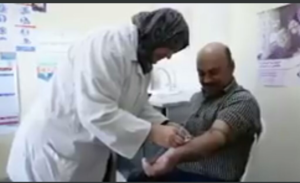 Regarding the mechanism of reading samples and mammograms, Dr. Al-Aboud said, “We have created a reference center for reading mammograms, and a reference laboratory for analyzing blood samples, as well as a reference data center affiliated to each center, in addition to one reference center for pathological anatomy in the governorate Health Directorate.
The mission of this center is to communicate to guide suspected cases according to the results received from the central data center to the nearest hospital to the beneficiary’s house in coordination with the directors of the health districts to determine the dates of the review and secure transportation. The Centre is responsible for providing the committee with the results of the tests conducted until the final diagnosis is reached. So, the campaign ends, but our work lasts long months after the campaign.
“If we say that the goal of the campaign in Homs is to reach 11016 samples per cancer, I am confident that we will achieve the goal and even surpass it in a large degree thanks to the spirit of cooperation and teamwork that I have touched myself in various health centers and mobile clinics in health areas, that created such a unique state of harmony and cooperation that it has made us unable to know whether the mobile clinic is part of the center or that the center is part of the mobile clinic.” Dr. Aboud concluded.
Interviewed by Amal Farhat
Photos by A. Farhat