
Music in Syria
A lot of findings indicating the Syrians’ love for and interest in music and singing were discovered in a place known today as «Tel Hariri». Those findings, which date back to more than 4000 years, show parts of the songs and lyrics which are considered as the oldest in humanitarian cultural heritage. The findings correspond to the oldest Akkadian musical script found in the thirteenth century BC.
Arabs in Belad el- Sham knew music, singing and musical instruments and they have been affected by the music of the previous civilizations including the Egyptian, Assyrian, Greek and Persian. They took from the Persian, Greek and Byzantine music what suits their music and singing. They used various musical instruments like lutes, flutes, mandolins, tambourines and drums.
During the weakness era of the Abbasid state, al- Mosul and Aleppo had become great centers for cultural life. Among the great musicians of this period were: Saif al-Doula al-Hamadani (944-967) who was an eloquent poet, Abu al-Tayeb Al- Mutanabbi and the great poet and philosopher Abu Nasr Muhammad al-Farabi, who was familiar with the science of Greece and was good at playing lute. Al- Farabi wrote several books including: ‘The great musician’, and ‘Words in the Music’
In 1058-1250, during the time of the Seljuk , the Ayyubid state and the Mamluk rule, Arab countries in general and Levant in particular suffered a lot of the Ottoman hegemony that affected all aspects of life especially music. Consequently, Arabic music was greatly influenced by the Turkish stereotype which affected the Arab music identity. Turkish Sultans were so interested in music that they used to bring most distinguished musicians and singers into their palaces to enjoy musical evenings. The Turkish musical theories and science were the same theories which were applied in the Arab countries and Persia. Among the Ottoman talented musicians whose compositions were played in the Levant and other countries were: Sultan Selim III, Yusuf Pasha, Osman al-Tanbouri and Hajji Arafi beck.
But, the best Syrian singers of the Sufis in the eighteenth century were: Mohammed bin Abdul Qader Al-Sharif 1688-1756, and Mohammed bin Kojak Ali Halabi 1694-1773, who had great knowledge of music as he composed and tuned several stanzas.
During the rule of Ibrahim Pasha, the art of stanzas, which was attributed to Aleppo, emerged at the hands of poet Ameen al-Joundi (1764-1837).
Ahmed Abu Khalil Qabbani and his lyrical theater appeared as unique phenomenon in music and singing during this period.
Music Clubs:
Syria, since the beginning of the twentieth century, has witnessed a true musical renaissance thanks to music clubs, as these clubs were able to prove their existence in spite of the great social and religious challenges. Late musician Shafiq Shabib, was the first to found a music club in Damascus in 1914 calling it “Eastern Music Club”. In 1925-1927, late musician Tawfiq Fathallah established another club aiming at defending musicians’ rights.
Several clubs and institutes were also established in Aleppo. The most famous of which were: « Aleppo Music Club » and « Shahba Club for Art», the «Club of the Armenian Association» and «Catholic Club». Sheikh Ali Darwish, and Sheikh Omar Batash, Ahmed Opry, Mamdouh Al Jabri and Omar Abu Risha were the most prominent members of these clubs.
The first official conservatory was founded by the state in 1943.
Conservatories:
The First Oriental Conservatory was established in 1943 during the era of President Taj al-Din al-Hassani to support the music clubs and conservatories in the country.
The second conservatory, which was the first formal institute affiliated to the Ministry of Education and called the Conservatory, was established in 1947. In 1950 a presidential decree was issued providing for the establishment of the Oriental Conservatory in Damascus. It was officially opened in 15/03/1951, but closed in 1959.
Arab Music Institute, known today as (Solhi al-Wadi Institute), was founded in 1960. It started its work according to the latest methods used in conservatories world over and it is still working until now.
Orchestras:
In 1961, Syrian musicians agreed to establish a large orchestra, led by Salim Sarweh on behalf of the “Artists Union”. 1962, witnessed the establishment of the “Dawn Band” led by Ameen al-Khayat. The Syrian Arab TV has also established its own band led by Ibrahim Abdel Aal. “Al-Hojra Music Band” led by Solhi al-Wadi was founded in 1967.
Music festivals: The annual festival of Peace and Amity, which is still being supervised by the Ministry of Culture, is one of the most important music festivals in the country. The festival, which is usually held in Lattakia, witnesses the participation of prominent musicians and singers from Syria and the Arab world.
The “Syrian Song Festival” in Aleppo, is held annually under the supervision of the General Commission for Radio and Television.
The Higher Institute for Music was established in the sixteenth of November 1990 with the aim of upgrading and developing the Syrian music and musicians.
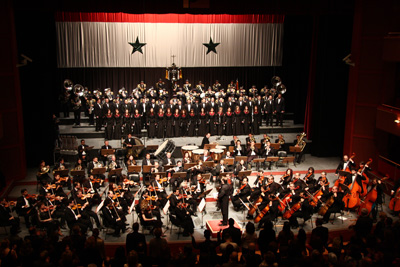
Syrian National Symphony Orchestra was created in 1992. It consists of eighty-five musicians and has played a large number of musical masterpieces during the concerts held mainly in Damascus.
Amal Farhat