
Moscow Never Hides Its Legitimate Arms Sales to Syria – Lavrov
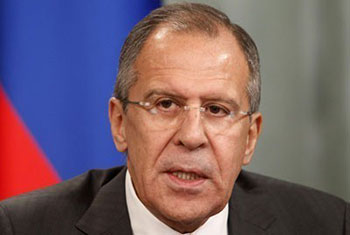
MOSCOW- Russian Foreign Minister Sergi Lavrov has announced that Moscow has never tried to hide its arms sales to Syria, because it is implementing the contracts which have been signed time ago. He stressed that any country has the legitimate right to have defense capabilities which are not prohibited by any international treaty.
Russia Today quoted Lavrov as saying to the British “Foreign Policy” Magazine that “those contracts are mostly about providing the Syrian government with anti-aircraft defensive weapons, and it is absolutely clear that Syria needs legitimately defensive capabilities because the threats are not invented, but they are quite real.”
He added “any country has the legitimate right to have defense capabilities which are not prohibited by any international treaty, and we are not violating any.”
He called for focusing on the other side and to take into consideration reports about the opposition being armed by offensive weapons, and by the weapons which have been also infiltrated from Libya.
“I believe that it is much more important to take a better look at the other side of the drama because the opposition is being armed by offensive weapons, by the weapons which have been also infiltrated from Libya, including MANPADs, which is a very dangerous weapon. And we have to take this information into account against the background of the leaders of the (Free Syrian Army) making public statements that airplanes, including civilian airplanes, and airports, including civilian airports, will be legitimate targets. This is very dangerous,” Lavrov said.
The Russian Foreign Minister renewed Russia’s call for halting violence in Syria and launching dialogue without any preconditions, referring to “some positive changes” which occurred on the part of those who have been denying any possibility for dialogue.
He added that this positive change occurred not only in the stances of Washington, Paris and other European capitals, but also in the stances of the Arab countries which are now saying things they did not say before, namely that there must be beginning of a dialogue.”
H. Mustafa