
Meteorite hits Russian Urals: Fireball explosion wreaks havoc, over 900 injured
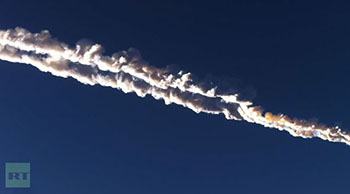

Russia’s Urals region has been rocked by a meteorite explosion in the stratosphere. The impact wave damaged several buildings, and blew out thousands of windows amid frigid winter weather. Hundreds have sought medical attention for minor injuries.
Around 950 people have sought medical attention in Chelyabinsk alone because of the disaster, the region’s governor Mikhail Yurevich told RIA Novosti. Over 110 of them have been hospitalized and two of them are in heavy condition. Among the injured there are 159 children, Emergency ministry reported.
Army units found three meteorite debris impact sites, two of which are in an area near Chebarkul Lake, west of Chelyabinsk. The third site was found some 80 kilometers further to the northwest, near the town of Zlatoust. One of the fragments that struck near Chebarkul left a crater six meters in diameter.
Service members from the tank brigade that found the crater have confirmed that background radiation levels at the site are normal.
 A hole in Chebarkul Lake made by meteorite debris. Photo by Chebarkul town head Andrey Orlov.
A hole in Chebarkul Lake made by meteorite debris. Photo by Chebarkul town head Andrey Orlov.
Experts working at the site of the impact told Lifenews tabloid that the fragment is most likely solid, and consists of rock and iron.
A local fisherman told police he found a large hole in the lake’s ice, which could be a result of a meteorite impact. The site was immediately sealed off by police, a search team is now waiting for divers to arrive and explore the bottom of the lake.
Samples of water taken from the lake have not revealed any excessive radioactivity or foreign material.
Weather sattelite Meteosat 10 has taken an image of the meteriote shortly after entering the atmosphere.
Weather sattelite Meteosat 10 has taken an image of the meteriote shortly after entering the atmosphere.(Copyright 2013 © EUMETSAT)
Russian space agency Roskosmos has confirmed the object that crashed in the Chelyabinsk region is a meteorite:
“According to preliminary estimates, this space object is of non-technogenic origin and qualifies as a meteorite. It was moving at a low trajectory with a speed of about 30 km/s.”
According to estimates by the Russian Academy of Sciences, the space object weighed about 10 tons before entering Earth’s atmosphere.
According to preliminary reports, the worst damage on the ground in Chelyabinsk was at a zinc factory, the walls and roof of which were partially destroyed by an impact wave. The city’s Internet and mobile service were reportedly interrupted because of the damage inflicted near the factory.
R.S