
Medical and humanitarian achievement despite the siege imposed on Syria
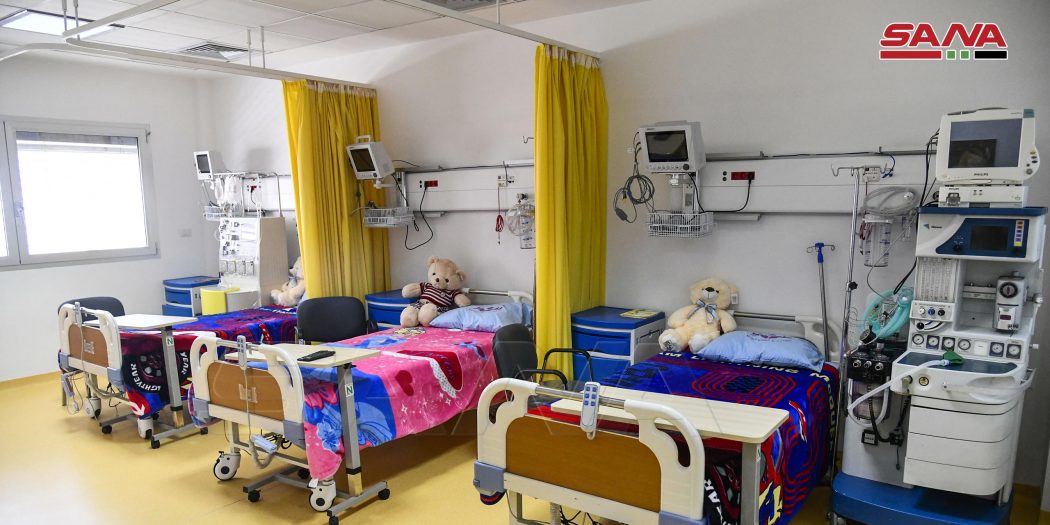
The first center for blood stem cell transplantation and cellular treatment for children is scheduled to be into service within the coming few weeks. This centre will be a medical and scientific achievement of increasing importance amid the challenges the country is facing due to the repercussions of the war and the economic blockade. It will give hope to a large segment of children and their families for recovery. It gives the opportunity to save the lives of children with hereditary blood diseases, congenital immunodeficiency diseases, congenital and hereditary metabolic diseases, leukemia and some types of solid cancers.
The center, located in a special department at the University Children’s Hospital in Damascus, is undergoing final preparations to open its doors in the coming weeks.
The idea of establishing the center was put forward 15 years ago, but its achievement faced great challenges in terms of infrastructure and technology and securing devices and advanced treatment methods. So it’s opening soon would be one of the most important experiences of success in challenging the siege that prevents Syria from keeping pace with global medical and research developments. This achievement represents the fruitful result of participatory efforts of the Cancer Control Committee team that includes specialists and official institutions, including the ministries of defence, higher education, scientific research, and health.
According to its director, Dr. Majid Khader, the center receives sick children from the age of one month to 14 years. It consists of two sections, namely, the Stem Cell Transplant Division, which is equipped with all the necessary infrastructure, medical equipment, sterilization techniques and high ventilation for transplantation operations.
The Stem Cell Transplant Division also includes an outpatient transplant clinic and a visiting room for patients to communicate with their relatives through internet-connected screens to ensure the safety of the patient’s psychological state and keep him away from feeling isolated or lonely.
The second section is a stem cell transplant laboratory equipped with the latest technical equipment.
Regarding the center’s work mechanism, Khader noted in a statement to reporters that the child remains in the transplant rooms with his mother for about a month and a half, in conjunction with the preparation of the cell donor.
Dr. Khader indicated that the patient’s health status is monitored from 5 to 10 years after transplantation, noting that the center’s capacity is to accept 5 children at the same time, to reach from 40 to 50 children annually. All services are provided to them free of charge, despite the high cost of more than 100,000 dollars in other countries. He asserted that the priority is for children with leukemia who are in severe condition, while the rest of the cases can be postponed for a specific time. The recovery rate generally ranges between 60 to 90 percent, depending on the case.
Dr. Khader clarified that the center will work to spread the culture of stem cell donation in the community through its own website, stressing that there are no effects on the donor, as the donors’ data is recorded and contacted when needed.
Head of the National Cancer ControlCommittee, Dr. Arwa Al-Azma, asserted that the center is the first of its kind in Syria, where there is a center for adult blood stem cell transplantation in Tishreen Military Hospital in Damascus. She noted that the center is in addition to its role in providing services to children with blood diseases and some types of cancer it will play a role in future in cellular therapy and a nucleus for stem cell research for some incurable diseases.
Dr. Al-Azma pointed out that despite the great challenges, the will and determination of the work team contributed to the success of the project.
The center, according to Dr. Al-Azma, is the first fully automated medical center in Syria, and it is the fruit of the plan developed by the National Cancer Control Committee.
Inas Abdulkareem