
“Maryamin Musicians” mosaic painting documented the rise of the Syrian musical renaissance
It was mentioned by “Yaqut al-Hamawi” in his dictionary and the leaders of “BaniHilal” built their palaces there as it became a center for their great and famous princes, such as “Abu Zaid al-Hilali” and others.
It is the village of “Maryamin”, whose mosaic painting was no less famous than its fountains , its mills, its aqueduct, and its water channels, its various flowers, and its archaeological and historical monuments.
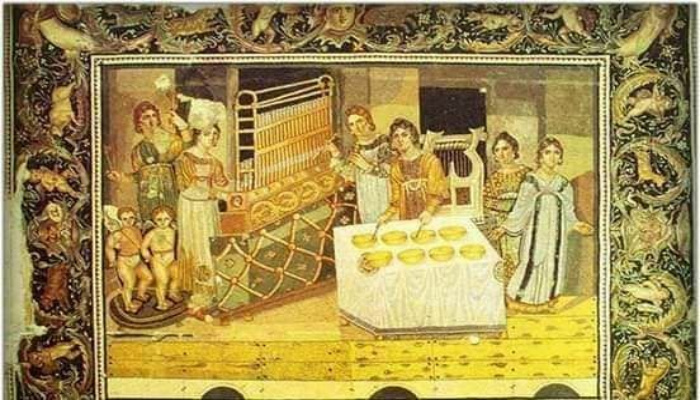
This painting, which was discovered in 1960, is considered one of the most beautiful rare mosaic paintings in the world. It is displayed in the National Museum of Hama, and is decorated with the five hundred Syrian pound banknote.
The uniqueness and importance of the “Maryamin Musicians” mosaic painting , which was drawn with delicate stone cubes , lies in the fact that it provided scientists and researchers with an artistic document on how to play the “organ” musical instrument in those days. The painting depicted a musical scene of an integrated musical band representing women from the Greek era playing musical instruments dating back to that period.
It is likely that it dated back to the era of Emperor Philip the Arab around (244-249 AD) and indicated that “Maryamin” village had made great progress in the world of music and playing . Very high-end concerts were held there during which sophisticated musical instruments were used from all parts of the ancient world, including Greek and Indian instruments.This stressed that Maryamin village was the home of the musical renaissance in Syria and it was the musical capital of Syria during the Roman era..
The painting marked the beginning of a new phase in which the long classical tradition and legacy ended, and it is considered one of the high-quality mosaic models that expressed the originality of the concept and meaning through the mastery and ingenuity of the artist who painted it.
RawaaGhanam