
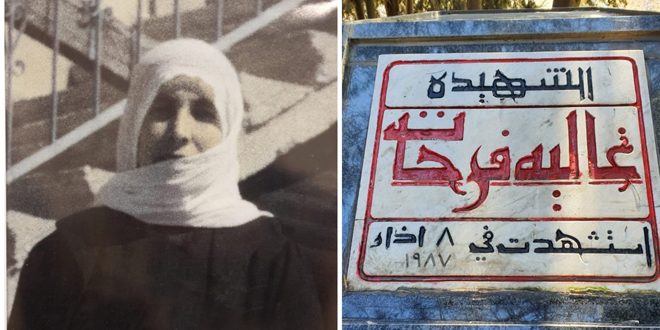
Martyr Ghalia Farhat an icon of female resistance in occupied Syrian Golan
March 8 in Syria marks two major occasions. One of them is the Revolution of the 8th of March 1963 which was a turning point in Syria’s modern history and an important achievement that helped Syria gain a key position in the Arab region and led to major economic and social reforms that reflected positively on all walks of life in the country. The other occasion is International Women Day which is commemorated every year with so much pride and respect for Syrian women who throughout history have been an example of sacrifice, patriotism and resistance against occupation and terrorism.
A shining example of those Syrian women is the Golanese heroine Ghalia Farhat, who was martyred on March 8, 1987 while participating in a celebration held to inaugurate the potable water network which was supposed to be set up by the Syrian government in the occupied Baq’ata village marking the country’s celebrations of March 8th Revolution.
On that day (March 8 1987), thousands of citizens from the occupied Golan villages of Majdal Shams, Beq’ata, Mas’ada and Ein Qinyeh gathered to celebrate the project of pumping drinking water from their motherland Syria to their houses in these occupied towns after the Israeli occupation authorities had blocked their access to drinking water.
Despite the curfew imposed by the occupation, locals from Baq’ata town took to the streets to celebrate this event. They gathered in an area adjacent to the ceasefire line which angered the Israeli occupation authorities. As a result, the occupation forces stormed the village, arrested dozens of youths and opened fire on the citizens, wounding many of them including heroine Ghalia Farhat who was providing assistance to other wounded persons. Farhat died due to her untreated wounds after she had bled to death because the Israeli forces prevented the locals from saving her.
The martyrdom of Ghalia Farhat took place while the world was celebrating International Women’s Day. Indeed, her blood represents a stigma of shame and barbarism , depicting Israel to the whole world for what it truly is.
Day of heroism
Ata Farhat, a journalist from the occupied Golan town of Beq’ata, described the day of Ghalia Farhat’s martyrdom as the day of heroism.
“Ghalia Farhat was martyred, but her sacred blood turned the streets and squares of Baq’ata, Majdal Shams, Mas’ada, Ein Qinyeh and al-Ghajar towns into an active volcano and an epic of steadfastness in the face of the occupation’s bloody acts,” Ata Farhat said.
On his part, Sa’eed Farhat, the son of heroine Ghalia Farhat, talked bitterly, yet proudly, about the loss of his mother.
“I was with her when she was struggling with death…the Israeli occupation authorities dealt savagely and aggressively with the situation by not allowing me or any of the locals to lend a helping hand to her until she died,” he said, adding that the occupation later isolated the Syrian Golan by cutting off all contact means.
“The martyrdom of my mother was not accidental as the occupation authorities claim. It was a deliberate crime aimed at preventing any national celebrations on March 8th Revolution anniversary,” her son clarified.
“Though 33 years have passed after my mother’s martyrdom I still talk to my daughter about her grandma’s heroism so we can feel as if she were still with us.” he pointed out.
Thousands of the people from the Syrian Golan and from occupied Palestine bade farewell to martyr Ghalia who left seven children and a national legacy for the coming generations to learn how a homeland’s dignity is defended.
Ghalia Farhat’s martyrdom on Women’s Day anniversary, has been turned into a national occasion that is commemorated every year by the people in the Golan and all of Syria to affirm that the struggle will continue against the Israeli occupation until the Golan is liberated and restored to Syrian sovereignty.
Hamda Mustafa