
Maritime Transport Corporation Generates Revenues of More Than 23 Billion Syrian Pounds
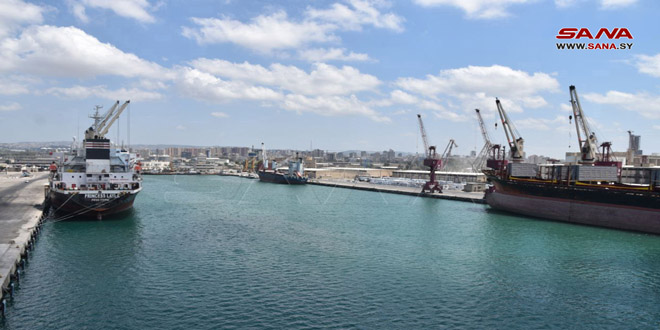
Lattakia (ST) – The maritime transport is considered as one of the most important strategic sectors that contribute to the process of the development and economic growth in general and that supply the balance of payments with foreign currency, which is necessary to cover the important activities of the national economy.
Despite the difficulties and unilateral coercive measures imposed on the country in general and the Maritime Transport Corporation and its ships in specific, the Maritime Transport Corporation, according to its Director General, Engineer Hassan Mahalla, was able to transport about 202,000 tons of goods on board its ships, with a completion rate of nearly 90 percent of its plan for the year 2022, achieving revenues that exceeded 23 billion Syrian pounds.
Mahalla told SANA that the corporation owns three modern ships, which are the bulk cargo carrier, Phoenicia, with a tonnage of 18 thousand tons, and two carriers of heavy loads and general cargo ships, Souria and Odessa, with a tonnage of 12,700 tons each.
He indicated that the plan for the current year included the improvement and renewal of the ships and training and qualifying the employees of the sailing crew of the Corporation according to the standards of international maritime training and qualification.
Vice President of Tishreen University for Open Education Affairs and a specialist in maritime transport economics, Dr. Maen Dayoub, pointed out that the current situation is exceptional and the economic sanctions imposed on Syria and on insurance companies require high insurance fees that lead to the increase in the cost of maritime transport.
Dayoub stressed that the global economy is currently facing a crisis in the field of fuel. The lack of fuel in Syria prevents it from providing services to the visiting foreign ships, which constitutes a loss of revenues from transportation fees that are recorded in the trade balance as receipts that supply the national economy.
He indicated that the unfair sanctions against Syria and its impact on the Syrian ports, in addition to the lack of the integrated logistical system that contributes to accelerating the process of unloading goods and their arrival to the final consumer, impede the development of the work environment and increase productivity and revenues.
Najla Khoury