
Malatius Jaghnoon, is a unique Syrian epigrapher
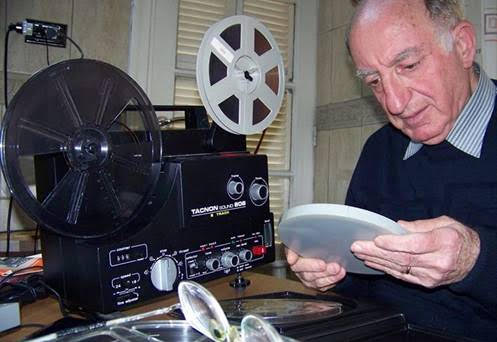
Malatius Jibriel Jaghnoon, is a Syrian engineer and epigrapher specialized in Aramaic and Greek inscriptions. He was born in Latakia , Jableh, in 1943. He graduated as a civil engineer from the University of Aleppo in 1968. His interest in epigraphy led him to learn several ancient languages including Aramaic and Greek.
Deciphering a number of Syriac and Greek inscriptions from an ancient church in Tal Eltiten, in the Al-Ghab area in Syria to the west of Apamea, an inscription from Maarrat al-Nu’man Museum and an inscription from the agora of Palmyra, were among his epigraphical works inside Syria.
He is a founding member of the Archaeological Society of Homs ” Al-Adiyat” and was elected as head of the society from 2011 until he left Syria several years ago.
He is the only one in Syria who can read ancient Greek inscriptions. He says: ” the science of epigraphy” depends on the study of the archaeological material, which is the written legacy, it is the most accurate legacy in describing and explaining our history, as the information is not taken from pottery, rock, clay, and minerals, but is taken from something written and dated by the discovered script after it was transmitted and decoded, then coming up with conclusions about the period in which it was written, at all levels: such as art history, architecture, economic and social history and all cultural aspects of human history. This science stands in the face of transmitted and falsified history, because it depends on the scientific facts that chemistry proves in estimating the age of the inscriptions.
Jaghnoon worked silently and uniquely, without receiving any attention or appreciation from any cultural institution . He said: ” After three decades of work in the field of epigraphy, throughout the region (Syria, Iraq, Lebanon, and Jordan) at the level of ancient Greek inscriptions , which I have devoted myself to after my retirement from the civil engineering profession, that I had the honour of being visited by the most important epigraphist in the world today, Mr. Louis Gatier, Professor at the University of Lyon -who surprised me by visiting me in my home in Homs in 2007 .
To show why he was attracted to this science, he said: ” there was unknown desire inside my soul that motivated me to study epigraphy, this was when, I visited Palmyra and Apamea for the first time in my life. I was a young man in the mid-seventies of the last century, when I stood in front of its columns what drew my attention were the inscriptions and writings engraved on these columns in Greek and Palmyrian. Despite my great admiration for the architecture of the ancient monuments there, I felt an unknown attraction to these inscriptions with a voice addressing me: “Oh, shame on you”, these inscriptions are messages from your Syrian ancestors and you don’t know what do they mean ? . Thus, motivated by this hidden invisible call, I searched a lot for the keys of the two ancient Greek languages (which differ from modern) and the Palmyrian. There was no teacher, no institute, and no sources I could rely on in order to reach my desired goal, so with a lot of persistence and perseverance, I managed to fulfill the occult call and became a reader of inscriptions, epigrapher.
It is mentioned that the researcher Jaghnoon has published several researches in the Syrian Knowledge Magazine, the STUDIA ORONTICA (Al-Asi Studies) specialized in Archeology, which was issued by the General Directorate of Syrian Antiquities and Museums, GDAM, the Syrian Journal of Researchers and in the Science Magazine.
The Canadian Center for Epigraphic Documents (CCED) at the University of Toronto honored Jaghnoon, so he published his first contributions on the first page of their specialized scientific journal, the “Journal of the Canadian Center for Epigraphic Documents’ (JCCED).
With the same love for his country, he was able to put the name of the beloved” Adiyat Homs” as a picture on the main cover of a periodical, archaeological journal specializing in epigraphy, the one that is published at the University of Toronto. The main cover page of the same magazine was decorated with the image of a Syrian Canonical mosaic discovered in Syria.
Amal Farhat