
Major reductions in seafloor marine life from climate change by 2100
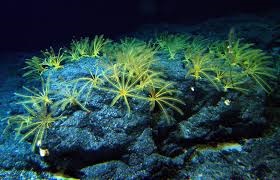
A new study quantifies for the first time future losses in deep-sea marine life, using advanced climate models. Results show that even the most remote deep-sea ecosystems are not safe from the impacts of climate change.
An international team of scientists predict seafloor dwelling marine life will decline by up to 38 per cent in the North Atlantic and over five per cent globally over the next century. These changes will be driven by a reduction in the plants and animals that live at the surface of the oceans that feed deep-sea communities. As a result, ecosystem services such as fishing will be threatened.
In the study, the team used the latest suite of climate models to predict changes in food supply throughout the world oceans. They then applied a relationship between food supply and biomass calculated from a huge global database of marine life.
These changes in seafloor communities are expected despite living on average four kilometres under the surface of the ocean. This is because their food source, the remains of surface ocean marine life that sink to the seafloor, will dwindle because of a decline in nutrient availability. Nutrient supplies will suffer because of climate impacts such as a slowing of the global ocean circulation, as well as increased separation between water masses — known as ‘stratification’ — as a result of warmer and rainier weather.
Lead author Dr Daniel Jones says: “There has been some speculation about climate change impacts on the seafloor, but we wanted to try and make numerical projections for these changes and estimate specifically where they would occur.
“We were expecting some negative changes around the world, but the extent of changes, were staggering. Globally we are talking about losses of marine life weighing more than every person on the planet put together.”
The projected changes in marine life are not consistent across the world, but most areas will experience negative change. Over 80 per cent of all identified key habitats — such as cold-water coral reefs, seamounts and canyons — will suffer losses in total biomass. The analysis also predicts that animals will get smaller. Smaller animals tend to use energy less efficiently, thereby impacting seabed fisheries and exacerbating the effects of the overall declines in available food.
Source: Science daily
N.H.Kh