
Lavrov Says Iran’s Participation in Settlement of Crisis in Syria Very Important
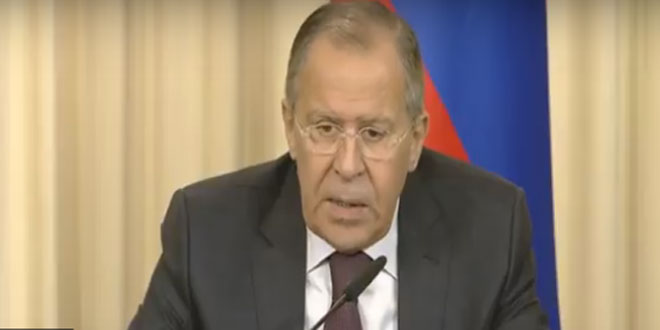
MOSCOW-The settlement of the crisis in Syria requires the involvement of Iran in this process, Russian Foreign Minister Sergey Lavrov said on Tuesday, according to Itar Tass.
The Russian foreign minister made this statement in reply to a question about how he viewed US President Donald Trump’s latest remarks about Tehran.
As Lavrov said, the solution of problems in the Middle East and North Africa requires the participation of external actors “which influence the situation on the ground in one way or another.”
“To a full extent, this also refers to Iran and to what has to be done to settle the crisis in Syria,” Lavrov said.
“The International Syria Support Group (ISSG) focuses precisely on the principle of inclusiveness, the principle of involving all external actors, and Iran is in the nucleus of this group,” the Russian foreign minister said.
“The Astana process is also based on the principle of inclusiveness, considering that Russia, Turkey and Iran have come up with an initiative of a direct inter-Syrian dialogue with the participation of the government and the armed opposition,” Lavrov noted.
During his two-day visit to Saudi Arabia last weekend, the US president accused Iran of being responsible for the unstable situation in Lebanon, Iraq, Yemen and Syria and called on all nations to isolate Iran.
Lavrov Warns Crisis in Syria will Stay Unresolved if Efforts to Divide it Continue
Lavrov also said that the problem of Syria will stay unresolved if the approaches splitting the country along religious lines continue to be pushed ahead.
“Tackling any problems, including those we see in the Middle East and Northern Africa, will be possible only on the inclusive basis,” Lavrov said. “This implies the need for all ethnic, religious and political forces of any country concerned, be it Syria, Iraq, Yemen or Libya, to participate in each particular case. It also applies to the need for the involvement of all external actors who one way or another influence the situation in the field.”
“The problems of Syria will not be resolved, if the approaches that split, and not unite, continue to be pushed ahead with,” he said.
H.M