
Lavrov and Zarif: The need to eliminate terrorism in Syria and preserve its sovereignty and territorial integrity
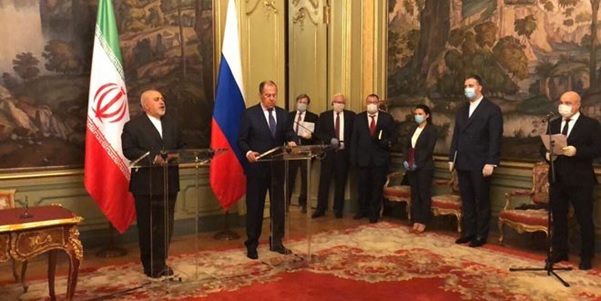
On June 16, Russian Foreign Minister Sergey Lavrov and Iranian Mohammad Javad Zarif stressed the need to eliminate terrorism in Syria and preserve its sovereignty and territorial integrity.
During a joint press conference with Zarif in Moscow, Lavrov stressed the need for international community to support the reconstruction process in Syria and provide humanitarian aid away from politicization.
“ The Astana agreements on resolving the crisis in Syria, confronting terrorism and preserving the territorial integrity and sovereignty of Syria must be implemented,” Lavrov said.
For his part, Zarif stressed the need to continue working within the framework of the Astana Talks to solve the crisis in Syria, noting that the Presidents of the three guarantor countries (Iran, Russia and Turkey) will hold a video -conference meeting soon.
Zarif said that Western countries use their humanitarian concepts to implement their political agendas, stressing the need for international cooperation on the humanitarian situation in Syria and providing humanitarian aid to those who deserve it, without any politicization.
Regarding the pressure exerted by the United States on Iran, Lavrov said that Washington’s efforts to extend the arms embargo imposed on Iran are illegal and have no prospects.
Lavrov reiterated Moscow’s stance calling for the preservation of the Iranian nuclear agreement, noting that Washington is impeding the implementation of the joint work plan on it, calling on China and the rest of the countries to cooperate with Tehran in this regard.
For his part, Zarif stressed that his country is committed to the nuclear agreement and cooperates with the International Atomic Energy Agency (IAEA ) and Washington is the one that did not abide by its obligations under the agreement and uses all means to pressure Iran since its exit from it and this matter is unacceptable.
Zarif said that Iran did not oppose the principles of the International Atomic Energy Agency, but rather supported efforts to maintain the nuclear agreement, pointing out that Tehran relied on cooperation with Moscow to be transparent.
Zarif stressed that Iran would have an appropriate response if the IAEA doesn’t not commit to transparency in its decisions towards Iran.
O. al-Mohammad