
Joint Syrian-Italian archaeological mission begins its work in Amrit
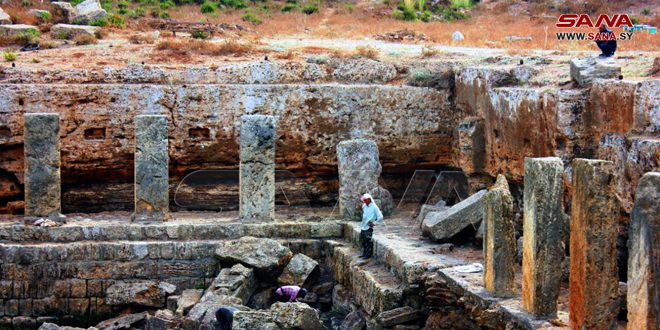
The joint Syrian-Italian archaeological mission began the work of the first season at the Amrit site in Tartous governorate, which included documenting a temple that is unique in the world in terms of its architectural plan and the decorative elements that adorned it, in addition to the preparations for future restoration work.
The director of excavation and archaeological studies and head of the mission on the Syrian side, Dr. Hammam Saad, said in a statement to SANA reporter that it is the first mission in years. The work of the first season includes cleaning of collapsed stones and dust inside the temple. There will be three-dimensional documentation work for each stone in the next stage, and then the necessary studies and plans for the next stage will be conducted to start conservation and restoration work inside the temple.
He indicated that the work of all foreign missions stopped in 2011, with the exception of the Hungarian in Al-Marqab Castle, which remained continuous, and the Czech one in a site in Lattakia Governorate. As for the Syrian-Italian mission, it is new and its first work is in Amrit.
He clarified that the return of archaeologists to work in archaeological sites is evidence of the return of security and stability and the completion of their work in the region, which is exceptional in its civilizations and successive periods, not at the level of the region, but at the world level. He stressed the importance of the return of archaeological work to sites in Syria, in addition to the important role of the local community in preserving and protecting these sites.
Dr. Marina Bucci from the University of Florence in Italy underlined the importance of the joint Syrian-Italian meeting, noting that the excavation work is linked to an agreement between the Research Center in Italy, the University of Florence and the General Directorate of Antiquities and Museums. She indicated that its work depends on the documentation, preservation and restoration work of the unique Amrit temple, which has exceptional importance in terms of completed items and preservation of the Phoenician Era.
She pointed out that the mission at the site includes from the Italian side a group of topographers and stone specialists to find out the correct mechanism for restoration work in the next stage, followed by conservation and preparation for restoration work in the coming seasons.
Inas Abdulkareem