
Jiroud’s last Hand Grape Molasses Press Tells the Secrets of an Endangered Profession
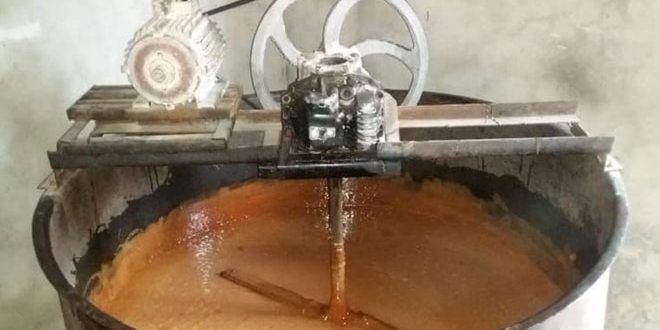
The handmade grape molasses industry is one of the ancient and inherited industries in a number of Syrian cities that enjoys abundant vineyard crops that cover large areas of their lands.
At the end of the grape- picking season in September and the early days of October of each year, people begin making grape molasses by using traditional presses.
In Jiroud located in the countryside of Damascus , “Nada” press is the only remaining mill that is part of the hand-made tools for making grape molasses .The people of Qalamoun inherited this from their ancestors as an annual tradition they use it to provide a sweet-tasting winter supply that gives warmth.
Khaled Nada opens his press every year at this time to start a traditional family business that is more than two hundred years old, producing about six tons of grape molasses.
This craft, which he is afraid of it becoming extinct , brings him an income to support his family, especially since these mills are struggling today to maintain their presence in front of industrial machines, as he put it.
Nada believes that the handmade molasses presses are part of the heritage identity of the region and a source of livelihood for their owners, especially that their products are widely admired by the people. He fears that the traditional molasses presses would have the same fate of the ancient stone presses that were prevalent in the villages of Qalamoun, but are today forgotten heritage monuments.
As for working in the press, which is more than two hundred years old, Nada explained that he gets it ready around these days every year to start producing molasses, which is a work that requires experience and patience.
 The first step begins with spreading the raisins on the ground and threshing them frequently, and then collecting them in spherical blocks that are kept for 10 to 15 days to dry completely and become hard, and then the “iron hammer” breaks them down into small slices
Nada went on to say, “the slices are transferred to clay pots, where they are soaked in water for four days, after which they turn into a very sweet juice. Then it is moved to a big copper pot called “Al-Jailah” in preparation for cooking on firewood stoves with permanent stirring with wooden tools until the mixture is completely cooked. After that, the molasses is cooled for two days to be emptied into pottery containers.”
Agricultural engineer Talib Talib explained that grape molasses uses raisins ,which are characterized by high levels of sugars, up to 30%, and have health benefits; it can also be used in the manufacture of some types of sweets and popular dishes.
Amal Farhat