
Island lizards are expert sunbathers, and researchers find it’s slowing their evolution
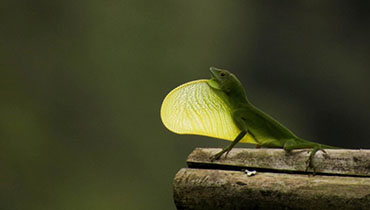
If you’ve ever spent some time in the Caribbean, you might have noticed that humans are not the only organisms soaking up the sun. Anoles — diminutive little tree lizards — spend much of their day shuttling in and out of shade. But, according to a new study led by assistant professor Martha Muñoz at Virginia Tech and Jhan Salazar at Universidad Icesi, this behavioral “thermoregulation” isn’t just affecting their body temperature. Surprisingly, it’s also slowing their evolution, according to Science Daily.
The idea that evolution can be slow on islands is actually somewhat strange. Islands have been recognized as hotspots of rapid evolution, resulting in many ecologically diverse species. The reason why evolution often goes into overdrive on islands has to do with the ecological opportunity presented by simplified environments. When organisms wash up on remote islands, they find themselves freed of their usual competitors and predators, which frees them to rapidly diversify to fill new niches. This phenomenon of faster evolution is often referred to as the “island effect.”
Yet, the researchers discovered that physiological evolution in Anolis lizards is actually much slower on islands than on the mainland. What is causing evolution to stall?
The same ecological opportunity that frees island organisms from predators also facilitates behavioral thermoregulation. “Whereas mainland lizards spend most of their time hiding from predators, island lizards move around more, and are able to spend much of their day precisely shuttling between sun and shade,” said Muñoz, assistant professor in the Department of Biological Sciences in the College of Science.
If it gets too hot, island lizards simply go find a shady spot. If it gets too cold, they can dash onto a sunny perch. By thermoregulating, island lizards are not just buffering themselves from thermal variation. They are effectively shielding themselves from natural selection. If lizards aren’t exposed to extreme temperatures, then selection on physiology is weakened. The result? Slower rates of physiological evolution. Effectively, island lizards use behavioral thermoregulation like SPF against natural selection!
Jhan Salazar said, “Our results show that faster evolution on islands is not a general rule.” This slower physiological evolution on islands stands in stark contrast to morphology, which has been shown to evolve faster in island anoles. When it comes to morphology and physiology on islands, it seems we are looking at different sides of the same coin. The same ecological release from predators and competition that allowed for the truly impressive amount of morphological diversification that has appeared quickly among island anoles, seems to additionally allow for more behavioral thermoregulation which slows physiological evolution.
“We are discovering that organisms are the architects of their own selective environments meaning that behavior and evolution are locked together in a delicate dance. This pas de deux tells us something important about how diversity arises in nature,” said Muñoz.
N.H.Kh