
Iranian Foreign Ministry: Any aggression against Syria is a flagrant and condemnable violation of international laws
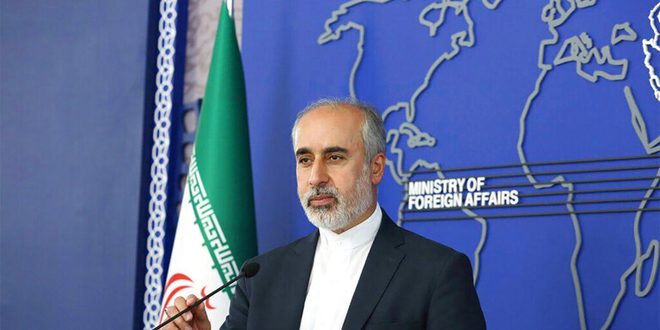
On November 21st, Iranian Foreign Ministry spokesman Nasser Kanaani confirmed that any aggression against Syria or violation of its territory and territorial integrity represents a flagrant violation and a condemnation of international laws.
On the repeated Zionist aggression against Syria, Kanani considered in a press conference that the silence of international forums and the United Nations Security Council and the failure to give decisive and deterrent reactions is one of the reasons for this continuous aggression on Syrian soil.
He called on international organizations, the United Nations and the Security Council to give a serious reaction to this aggression.
Kanani pointed out that for years the Syrian people were a victim of the illegal Zionist attacks, and in this regard, we support any action that the Syrian government does to protect itself and ensure the security of its people.
On the other hand, Kanani said: “The decision of the International Atomic Energy Agency Council against Iran is caused by political pressure from America and the European trio.”
He pointed out that America and Western countries are following an approach to influencing our relations with the International Atomic Energy Agency.
He indicated that Iran has announced its position, and considers politicizing the issue of human rights not constructive, pointing out that these countries use the issue of human rights for political purposes.
Kanani stressed that Iran believes in respecting the sovereignty of Iraq and its territorial integrity, and welcomes its sovereignty and dominance along the border strip between the two countries.
Kanani said: “Any increase in the American military presence in the waters of the region shakes stability and peace in it, and we believe that the best way to establish peace and enhance stability, especially in international and regional waters, is to expand and consolidate cooperation between the risky and regional states.”
O. al-Mohammad