
Iran, Russia Presidents Discuss Crisis in Syria, JCPOA over Phone
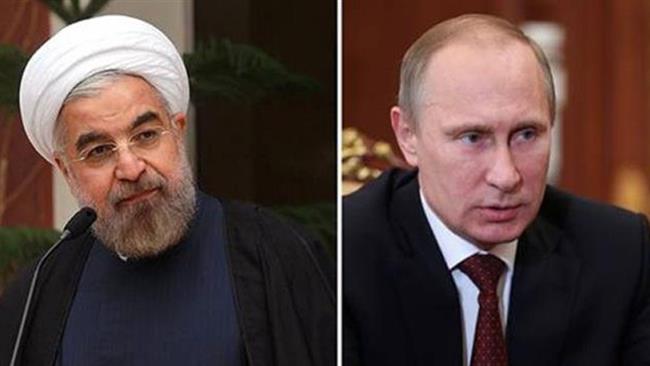
The presidents of Iran and Russia have discussed the latest mutual, regional and international issues, particularly the developments in Syria and the implementation of Iran’s nuclear deal with the P5+1 group of countries, in a telephone conversation.
During the conversation, the Iranian president pointed to cordial relations between Tehran and Moscow and stressed the importance of further developing bilateral cooperation, particularly in trade and economic sectors.
“Tehran welcomes active presence of Russian investors and private sector in implementation of important infrastructural projects, including in such sectors as industry and energy,” Rouhani said.
Referring to the existing situation in the region, he emphasized that Iran and Russia must hold more consultations on resolving regional issues and especially on fighting terrorism.
The Iranian chief executive also stated that the landmark nuclear agreement, known as the Joint Comprehensive Plan of Action (JCPOA), reached between Iran and the P5+1 group of countries in 2015, was a multilateral deal and emphasized that recent US measures were in violation of the agreement.
“The Islamic Republic of Iran has always been committed to all its obligations and reports by the International Atomic Energy Agency (IAEA) have verified this reality,” Rouhani said.
Iran and the five permanent members of the UN Security Council – the United States, Britain, France, Russia and China – plus Germany reached the JCPOA on July 14, 2015 and began implementing it in January 2016. Under the agreement, limits were put on Iran’s nuclear activities in exchange for, among other things, the removal of all nuclear-related bans against the Islamic Republic. The UN Security Council later unanimously endorsed Resolution 2231 that effectively turned the JCPOA into international law.The IAEA has on multiple occasions confirmed Iran’s adherence to its commitments under the JCPOA.
Iran, Russia efforts bring stability to region
The Russian president, for his part, said his country’s economic activists and investors were keen to participate in Iran’s infrastructural projects and called for the implementation of agreements previously signed between the two countries.
Putin highlighted the need for Tehran and Moscow to boost cooperation in various fields, adding, “Fortunately, due to the efforts made by Iran and Russia, we are currently witnessing good achievements with respect to restoring stability to the region.”
He noted that the IAEA had verified Iran’s compliance with the JCPOA and emphasized that violation of the deal by any side would be a breach of the UN Security Council Resolution 2231.
Russia Eyeing Joint Energy Projects with Iran
During the phone conversation Russia indicated its eagerness to expand economic cooperation with the Islamic Republic as President Hassan Rouhani is preparing to start his second term in office.
The Kremlin announced in a statement that Putin and Rouhani discussed the prospects for implementing joint projects.
The Kremlin said Putin had specifically talked about doing “projects in the oil and gas, electricity and transport sectors,” Reuters reported.
Iran had already announced that it would welcome the participation of Russian corporations in the development of its oil and gas fields.
Earlier, the National Iranian Oil Company (NIOC) announced that it had received a proposal from the Moscow-based energy giant Gazprom over a key oil scheme – Changuleh – located in western Iran close to the border with Iraq.
Gazprom has also signed an agreement with a major Iranian contractor company – the Oil Industries’ Engineering and Construction (OIEC) – to cooperate over Changuleh as well as Azar oil field which is believed to be shared with Iraq’s Badra.
Azar and Changuleh were discovered in 2005 as a result of explorations conducted by a consortium comprising Russia’s Lukoil and Norway’s Statoil. Both fields – together with Iraq’s Badra – are believed to hold an in-place reserve of about 3.5 billion barrels.
Russia is also pursuing an ambitious multimodal transportation project – the North South Transport Corridor (NTSC) – which connects India’s Mumbai to Saint Petersburg and beyond. Iran lies at the heart of the NTSC which is seen as a cheaper and faster rival to the existing transportation routes through which goods are shipped from Europe to Southeast Asia through the Suez Canal.
PRESS T.V
R.S