
Insights About The Political Situation In Syria _ Part II
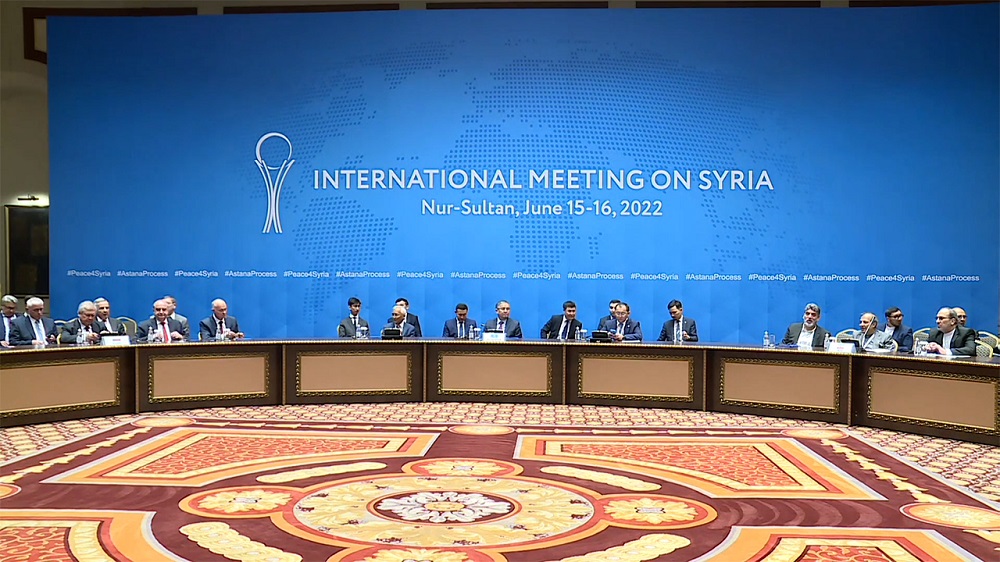
The Tehran summit dealt with several issues, including the political and operational repercussions of the US military presence in the northeastern region of Syria, and the possibility of resolving the bilateral tracks of Astana and Geneva, so that the first track is maintained to manage the situation by the three guarantor countries with the second track, which is not making progress and the possibility of rapprochement between the Syrian and Turkish regimes, which has witnessed increased activity between the two sides.The intelligence cooperation between them has existed for a long time and is still ongoing, and the visit of the Iranian Foreign Minister to Ankara on June 27, and his visit to Damascus on July 3, may have created undeclared understandings that were put forward in the Tehran meeting, which may be the reason, which prompted the Syrian Foreign Minister to arrive in Tehran during the tripartite summit meeting. It seems that these understandings led the meeting parties to agree on the necessity of the withdrawal of US forces from Syria, and the extension of the Syrian state’s control over all lands, especially in the north, which prevents Turkey from insisting on its invasion.The Syrian scene is one of the focal points in the Middle East in relation to the international changes that the world is witnessing today. As a result, only a few days after the end of the Tehran summit, the Turkish Foreign Minister stated that his country was fully prepared to support the Syrian regime in confronting the YPG/PKK organization, or the “terrorist organization”, as he described them. On 27/7/2022, according to what was reported by Anadolu Agency, his country had previously held talks with Iran regarding the expulsion of “terrorists” from the region, adding:”We will provide all kinds of political support to the work of the Syrian government in this regard.” He added that it is the natural right of Syria to remove the “terrorist organization” from its territory. This was followed by another statement in which the Turkish Foreign Minister revealed a meeting that took place between the two foreign ministers in Belgrade, on the sidelines of the Non-Aligned Summit. The summit, which was held between the Russian and Turkish presidents may have paved the way for the possibility of a close contact between the Turkish and Syrian presidents.It seems that the influential forces in Syria recently agreed, at the Tehran summit, to speed up the negotiations between the SDF and the Syrian government which are being conducted under Russian auspices and in coordination with Iran, in order to enhance rapprochement between the two parties. The recent period, specifically since last June, has witnessed tangible progress in this regard, as the Syrian forces have made military reinforcements in the areas of SDF influence, in the countryside of Aleppo and Al-Hasakah, and these forces have also been deployed in the areas of Manbij and Tal Rifaat, north of Aleppo Governorate.Finding solutions on Syrian soil has become a demand for everyone, and these solutions require the departure of the military forces of the United States of America supporting the “Syrian Democratic Forces” (“SDF”) and the “Maghawir al-Thawra” faction from the Syrian territories. It also requires not allowing a Turkish invasion of northern Syria, which requires that the Syrian state not be hindered in extending its influence over these areas. This prompted the SDF to rush to strengthen its relations with Moscow and Tehran, and to cooperate with the Syrian government.The observer of the current Turkish policy finds that it is trying again to apply the “zero problems” policy, and it started by restoring normalization with a number of parties that have been hostile to it, such as Saudi Arabia, Armenia, Egypt, the Emirates and “Israel”, and it has become a duty for them to achieve new relations with the neighboring countries surrounding it-to return to the “zero problems” policy.The region is witnessing many challenges. Many factors have contributed to enabling Iran to improve the terms of negotiations related to the nuclear agreement, and to enable the Arab Gulf states to reject military alliances, and to single them out with new political positions. In addition, Arab and non-Arab relations with Syria began to return gradually, several years ago, and the possibility of stopping the freezing of its membership in the League of Arab States exists.And the Russian position changed after the war in Ukraine regarding the Russian-Israeli understandings regarding the Israeli military operations in Syria. . Moscow also declared that the continuous Israeli bombing of targets in Syria is a violation of international law, and an irresponsible and unacceptable act.
Reem Haddad
Editor – in – Chief