
ICJ resumes public hearing on legal consequences arising from Israel’s policies in Palestinian territories
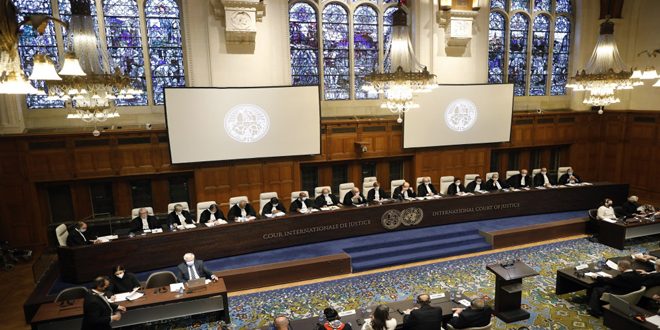
The International Court of Justice (ICJ) in The Hague resumed its public hearings on the legal consequences arising from Israel’s policies and practices in the occupied Palestinian territory, including East Al-Quds (Jerusalem).
In his briefing before the court, South African representative Vusimuzi Madonsela stressed the need to allow the Palestinians to exercise their right to self-determination.
He stressed that the Israeli violence and attacks on Gaza contradict international law, and that the Israeli attacks there are “more horrific than the apartheid regime.”
Madonsela pointed out that the Palestinians in the West Bank and Al-Quds are confined behind an apartheid wall, and that what Israel is doing exacerbates the conditions of the Palestinians and makes them worse, stressing the need to hold perpetrators of Israeli crimes responsible and hold them accountable.
He said that denying the right of return and not stopping settlement led to the current conditions in Palestine, and led to injustice and the perpetuation of the apartheid system and settlement rule, and that the delay in reaching a just solution led to an endless cycle of violence.
Madonsela added that the position on the apartheid regime must be clear, and that the occupation continued for a long time, 56 years, in defiance of all international regulations and laws and hundreds of United Nations resolutions and turning the back of the entire international community.
He stressed that the international community must ensure that the apartheid regime and its heinous practices against the Palestinian people must end, and that whoever commits these acts must be held accountable, and the wall and settlements must be dismantled, but Israel did not care about all these calls, and legislation and laws and continued to fight the court’s decision.
Madonsela added that the Palestinian people suffer from a system of racial segregation and discrimination based on policies, house demolitions, and raids into villages and refugee camps.
He explained that the legal system practiced against the Palestinian people, specifically children, is a military legal system applied by military judges without the lowest levels of protection or application of international humanitarian law, but the Israeli settlers in the West Bank have a completely different law, and as for the Gaza Strip, they live in a besieged area, completely separated from the West Bank, where they have been subjected to Israeli aggression for many years.
The representative of Algeria said that the United Nations resolutions explicitly stipulate an end to the Israeli occupation and that it is an illegal and illegitimate occupation, and that the occupation is the reason behind all recorded crimes.
He added that the request of the United Nations General Assembly must be responded to and the focus must be on reviewing the effects of the extended Israeli occupation in the Palestinian territories, and all its consequences arising from it, and the illegal system that prevails and that is based on racial discrimination on the basis of violating the standards and rules of international law stipulated by the United Nations General Assembly.
Algeria’s representative added that the court must exercise its jurisdiction and issue its decision based on the evidence presented to it about the consequences of the occupation and the ongoing conflict, and therefore “we in Algeria believe that the court must issue its decision and follow up on those decisions, as Israel has continued to build the separation wall despite the decision issued by the court, were ignored.”
Source: WAFA News Agency