
How WOLVES can co-operate with humans just like dogs: Ferocious canines are as capable of following handler’s commands – but they show more initiative than domesticated pets
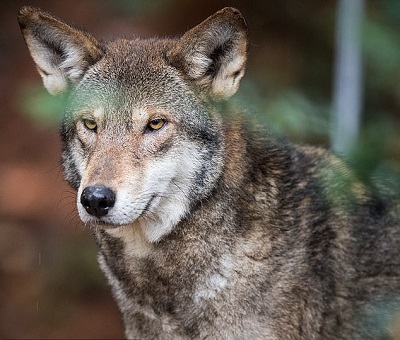
Wolves reared by humans can learn to cooperate with their handlers just as well as domesticated dogs, a new study has found.
Wild wolves work together to hunt, rear their offspring and defend their territory, traits which have been passed down to modern dogs – their closest relatives.
Experts tested the extent to which dogs and grey wolves collaborate with humans in order to solve a range of tasks, according to Daily Mail.
They found that both dogs and wolves cooperate intensively and equally successfully, but wolves show more initiative where dogs follow a human’s lead.
The experiment, conducted at the University of Veterinary Medicine Vienna, looked at how wolves and dogs cooperated with humans to solve specific tests.
The study tested 15 young grey wolves, aged from two to eight years old, and 12 mixed-breed dogs, from two to seven years old, at the Wolf Science Center in Austria.
All the animals in the study had been raised in similar conditions and had been exposed to humans early in their lives.
In a written statement Dr Friederike Range, who led the study, said: ‘The detailed analysis of the cooperative interactions revealed interesting differences between wolves and dogs.
‘It shows that, while wolves tend to initiate behaviour and take the lead, dogs are more likely to wait and see what the human partner does and follow that behaviour’.
The results showed that while both dogs and wolves cooperate with humans, wolves were more ‘proactive’ at initiating cooperation than dogs.
The wolves were more likely to initiate movement with humans and ‘lead’ the cooperation, while dogs would wait for humans to initiate and follow with movements as a result.
The researchers suggest that the ‘timidness’ they observed in dogs may have been due to the more submissive personalities being bred into modern species.
Dogs and wolves diverged between 20,000 and 40,000 years ago years ago, when canines were first thought to have been domesticated.
The latest findings are in line with previous study from the same Vienna research group which found that wolves are much better at collaborating with each other than are dogs, indicating that domestication weakened dogs’ ability to collaborate amongst themselves.
The results called into question the traditionally held thought that domestication caused dogs to evolve greater cooperation abilities.
N.H.Kh