
Hazm Village in Sweida Contains the Largest Basalt Door in Syria
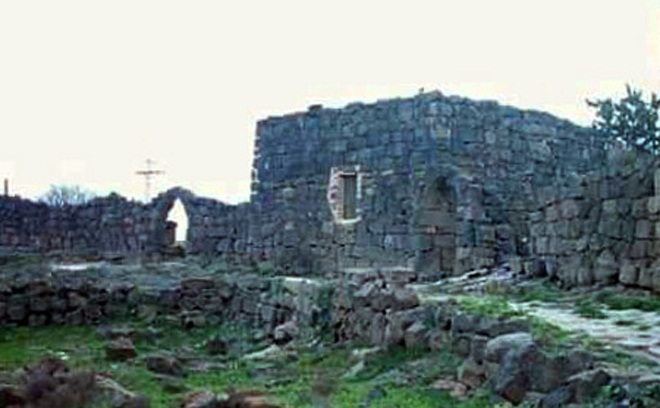
The village of Hazm, which is located in the basaltic Lajat region in Sweida province , tells the story of civilizations that have passed over the region since the third millennium BC..
The village is famous for its ornate old houses, which were built of basalt stones, in addition to the monuments including stone doors and channels to draw water from the old wells and ponds, which were used by man ,who inhabited the area , for various purposes.
Head of Sweida Antiquities Department, Dr. Nashaat Kiwan, told SANA that Hazm village was mentioned in ancient references by historians, travelers as well as Arab and foreign archaeologists because it contains the largest basalt stone door in Syria, which is 2.6 meters high and dates back to the Roman era.
Kiwan pointed out that Hazm was inhabited for long periods, especially during the Nabataean, Greek, Roman, Byzantine and Ghassanid eras, up to the Arab and Islamic era.Among the most important of its antiquities are the remains of houses that still keep their doors and stone arches, tanks to collect water and the ruins of ancient dams.
He added that Hazm village also contains about sixty Roman wells for preserving water, which until recently were the only source of drinking water, in addition to many ancient Roman roads which were studied by a number of foreign archaeologists, who considered these roads as the most important transportation routes in the past.
Head of Sweida Department of Antiquities indicated that Sultan Al-Malik Al-Nasir during the Ayyubid era at the end of the 12th century AD visited the village of Hazm. The village was mentioned by the Swiss archaeologist J. Berckhardt in his book (Journeys in Syria and the Holy Land) . The French researcher Joseph Maskal in 1994 described the largest basalt door saying “I had never seen a stone door of this magnitude in the whole region”.
Hazm’s lands are also part of the rugged rocky lands of the Lajat region and contain various features of biological diversity and forested trees whose roots extend for thousands of years .The village is surrounded by many archaeological ruins , especially in the western and southern sides, which indicated the presence of human activity during ancient times and this continued until modern times in addition to the presence of the so-called (Al-Faht) hole , which is one of the most important archaeological features surrounding the village.
It is worth noting that Hazm village is located about 50 km to the north of Sweida city , about 32 km from the ancient city of Shahba and about 57 km to the south of the city of Damascus.
Rawaa Ghanam
