
Hana K. Korany, “the George Eliot of Syria”
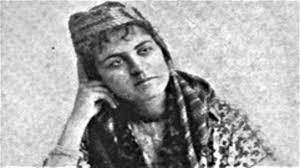
It was a revelation to discover such an influential feminist figure from my homeland Syria, who was a pioneer in publicly articulating about women’s lives in Syria in the late eighteenth century. Hana K. Korany, was a Syrian writer, who toured the United States, actively speaking on women issues in the Orient. She was labeled “the George Eliot of Syria” by one American newspaper.
Korany was born in a little village on Mt. Lebanon in the year 1871. Her parents were natives of Syria and belonged to good old families. She was educated at the American Seminary for girls at Beirut, where she studied science, art and the languages, graduated in 1885. She traveled to Malta, France, England, and America. In l887, she married Amin Effendi Korany.
Korany special work has been in the interest of her own country’s women. She was the first to appear as a public writer. Her principal literary works are a book entitled “Manners and Habits”, several essays, and four translations. She also wrote a novel in Arabic.
In 1893, Korany was invited by Bertha Palmer to represent Syria at the World Congress of Representative Women, an event associated with the Worlds Columbian Exposition that year. She also displayed Syrian women embroidery and handiwork at the fair, reported on the fair for Al Fatat, a woman magazine based in Egypt, and wrote an essay, “The Glory of Womanhood”, for the Congress of Women publication.
She went on a lecture tour in the United States after her Chicago activities were finished. In 1894, she attended the annual convention of the National American Woman Suffrage Association in Washington D. C., and spoke at a society dinner on the same program with Elizabeth Cady Stanton, Susan B. Anthony, Lillie Devereux Blake, and May Wright Sewall. In 1896, she founded a woman club in Beirut.
In 2020, a Syrian writer, Taissier Ahmad Khalaf, wanted to underline the influential role of Kourani, through a book under the title: The Early Feminist Movement in Ottoman Syria: the Experience of Writer Hana Kasbani-Kourani “, published by The Arab Center for Research and Policy Studies.
 It is noteworthy that Khalaf is a Syrian writer and novelist. He studied journalism at the Faculty of Arts at the University of Damascus, served as an editor in Arab newspapers and periodicals and as a full-time researcher at Tresearch centers in Damascus and Dubai. He has published a number of novels and non-fiction books, including his 2018 novel, The Birds of Darwin.
Khalaf’s book enriches our understanding of the forerunners of the development of a feminist movement in the Arab Mashreq, and shades light on the intellectual and philosophical currents influencing this emerging movement. Korany’s experience at the end of the nineteenth century offers rich material for scholars on a rare case of cultural interaction between East and West.
The first of the book’s three chapters details Hana Kisbany Korany’s participation in the first Chicago Women’s Conference, wherein her 1893 keynote address, with its stirring choice of words and eloquent English expression, delivered by a woman in distinctive Oriental apparel – and soon to become a star of the new world – forcefully overawed elite American cultural circles. Korany became a polished guest of the salons of the bourgeois class and a coveted speaker in literary and social fora exploring the mysterious world of the Orient, its customs and traditions, and the status of Oriental men and women.
Expounding on this, the author writes, “In a letter to her friend Hind Nofal, editor-in-chief of the al-fatāh magazine, Hana Korany expressed astonishment at the position of American women who enjoyed a first-class level of progress, because they “were not satisfied with their lot,” as she put it. In her message, nevertheless, she criticized what she referred to as “American women’s persistence in competing with men in political matters and in taking up administrative positions:
“I do not praise them for these great ambitions, because this disturbs the public ease, and above all destroys household happiness. It would be better of them to be satisfied with their high status and make an effort to rescue their sisters who have been sentenced from time immemorial to live in humiliation and disgrace,”.
Korani criticized Jean Jacque Rousseau, the famous French writer in “The Glory of Womanhood.” 1871, regarding woman’s “glory being unknown.” She responded: “He betrayed his doubt of her capabilities and her large intelligence, exhibiting as well his great selfish ambition in confining power and glory to men alone. Fortunately for woman, the storm of mental progress blew away this theory; for many women stand before the world in triumphant glory, victorious over all obstacles; striving they write in large letters of light on the margin of truth, “There is glory for woman that no shadow can eclipse.” The great-souled, noble woman has won and is crowned with laurel in spite of all the powers that have worked to keep her unknown. There is a glory in store for every woman, let her but labor for its possession.”
In her writings Kourani asks: Does a woman gain glory by sitting on the throne of royalty with the scepter of power, or by dwelling in palaces of luxury where all that money can buy is to be found? Never. Many who sat on thrones of dominion and power are only famous for cruelty, injustice, and even degradation; and many passed their lives in bondage to selfishness; departing, leaving none to sing their praises.
 Kourani believes that “Piety or purity is the garb of woman’s glory. Without it, all her wisdom, knowledge, intelligence and patience amount to nothing; for piety alone purifies the heart and mind, elevates the morals and uplifts womanhood. A woman should be wise if she would be glorious. [Page 360] Carrying with her the safeguard of knowledge, she avoids failure and is qualified to fight the battle of life and win the victory. Wisdom is the crown of glory and scepter of power for woman.“
After extolling the working and informed woman for the boundless capacity she enjoys to promote the civil and moral causes of humanity, she called on her nation’s kin and her gender to take the lead, observing that it is impossible for a woman to keep up with a man in the forefront of knowledge and morals if she does not depend on herself, and pound on the door with her right fist, as she said, because “men, as are well known, give preference in sovereignty to themselves, endowing themselves with supremacy, and they specialize in the perfections of reason, wisdom, and experience. They believe themselves to be the sultans of the universe, endowed with absolute rule to which all must submit and to which all creatures are to be led, including women, by the lot.”
Hana Korany died in Kafr Shima on May 6, 1898, from Tuberculosis. The news of her death flew immediately to the American press, which received it with expressions of great regret, commemorating this Syrian who stormed through the most exclusive and influential of intellectual fora and cultural venues of the United States, befriending the American society’s elite.
Lama Alhassanieh