
Erdogan is a ‘Ruthless Tyrant Digging his Own Grave’
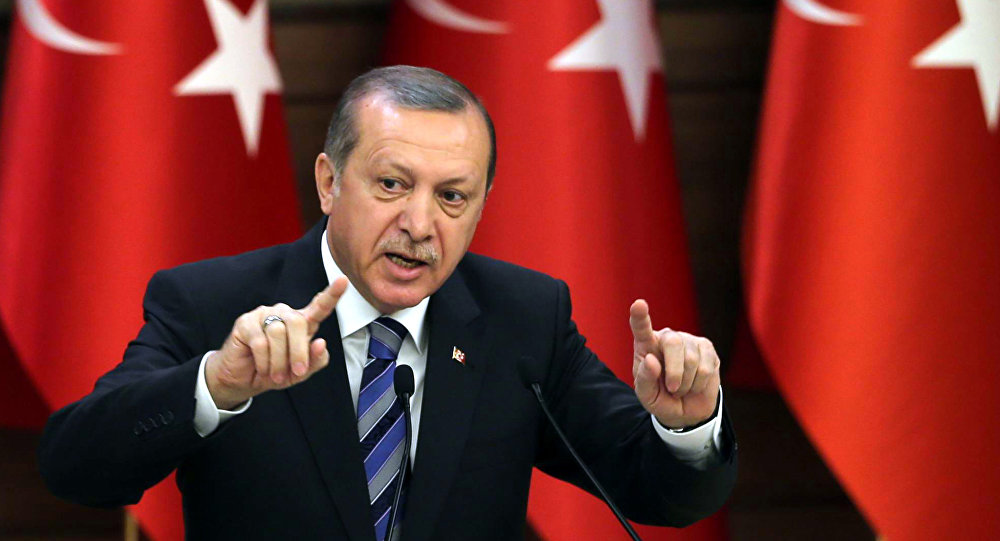
More and more western media sources now openly call Turkish President Erdogan a ruthless tyrant with a dangerous hobby of eradicating any form of opposition or freethinking; however, his strive for unilateral control over the country could end up entrapping him, given the recent challenges in the Middle East, Sputnik reported.
More and more western media sources now admit that Recep Tayyip Erdogan’s behavior “rings more and more alarm bells.”
In its recent analysis of the latest political developments in Turkey, the UK-based online newspaper Al-Arab calls him a “ruthless dictator with a dangerous hobby of eradication of any form of opposition and freethinking in the country”.
“Erdogan is harsh and cruel with everyone, without any exceptions; he gives no piece to anyone in his country, fearing threats even in his own home palace,” the newspaper says, referring to the recent changes in the country’s government and the resignation of Turkey’s former Prime Minister Ahmet Davutoglu.
“To put it simply, Erdogan thirsts for absolute power in his country. That is why he is alarmed by any criticism by his opponents of the developments in the country. Besides, he suppresses any critical remarks which come, even from his inner circle,” it adds.
His 14 years of dominance in Turkey have taken Erdogan down a long road, and he has ended up a ruthless dictator, harshly dispersing protesters and demonstrators, blocking undesirable mass media sources, restricting various freedoms and bargaining over refugees to suit his personal interests, it states.
He is trying to build a system where absolute power is concentrated in the hands of a president-tyrant. The Turkish president, who is quite eager to join the EU, won’t stop until he wipes out every one of his opponents or critics even if it is Turkey’s former Prime Minister Ahmet Davutoglu.
This view was echoed earlier by the UK Telegraph.
“Mr. Erdogan is now trying to subdue every possible challenge to his rule. Troublesome journalists go straight to jail, where they are joined by ordinary Turks found guilty of “insulting” their leader, in breach of the notorious Article 299 of the Penal Code,” it wrote earlier in March.
“Now Mr Erdogan wants to complete this maneuver by rewriting the constitution to create an imperial presidency, tailor-made for his own ambitions. As for how long he aims to rule, he talks of being ‘ready for 2023’ – the centenary of the republic’s birth,” it added.
“So Turkey has an instinctively authoritarian leader who treats the constitution as a personal plaything and plans for decades of dominance. How can this not be dangerous?” it went on to question.
In a separate analysis on the developments in the country, the US-based online conservative political website Front Page Magazine also calls Turkey “an Islamist tyranny that is getting worse by the day.”
“Once Obama held it up as a model for the Middle East. Now even he doesn’t want to have anything to do with it. But Turkish tyrant Erdogan has the EU over a barrel. The migrant crisis lets him blackmail Europe, turning the migrant tap on or off,” it says.
“And he’s making it clear that Turkey’s march into Europe will have no fig leafs of human rights. None whatsoever,” it adds.
However several outlets suggest that Erdogan’s foreign and internal policy might backfire at the president himself.
“Turkey is transforming to an Asian-style development model of a strong leader where decisions are made by the president and a small, unelected group of consultants,” Tim Ash, an economist for Nomura, told the US-based website Al-Monitor, which specializes in analysis from and about the Middle East.
“The danger is the weakening of the control-balance mechanism and quality of state governance.” Ash added, “The result will be weaker policies. Misguided policy choices could damage the long-term growth perspective.”
The website notes that because of increasing pressures on the central bank and political storms, Turkey’s annual growth rate has already slowed.
“The 2013 Gezi protests and corruption charges against the government, the 2014 presidential election and two general elections in 2015 have already put the Turkish economy under stress. Turkey’s annual growth rate, which for 50 years had averaged 4.5%, remained at an average 3% in the past four years,” it recalls.
Source: Sputnik
H.M