
Engineering students design a device for blind people
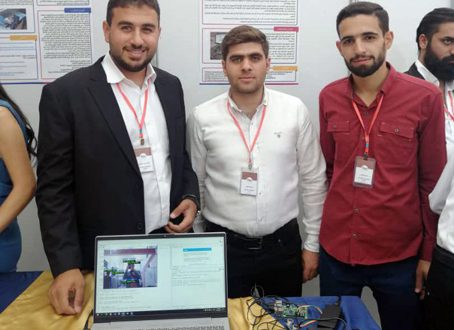
With the aim of transforming the blind from a person who needs special care to someone who can rely on himself and secure his own needs at a limited cost, students Saad Eddin Jamous, Adnan Maatouk and Hassan El-Asal from the Department of Electronics and Communications Engineering at the Faculty of Mechanical and Electrical Engineering at Damascus University worked on designing a device capable of compensating the blind with stronger hearing .
Jamous explained that with the development of technology and artificial intelligence, the idea of designing a device that is capable of compensating the blind for the sense of vision with the sense of hearing began to appear and transform vision into an audio alert that tells the blind about what things are in front of him and the environment around him in an artificial intelligence way through a digital vision system that transforms what the camera sees into audio alerts.
As for the advantages of the device, Maatouk stated that it identifies the things that the blind need in their daily life, such as household necessities, some types of clothing, food, people, pets, and motorized vehicles that the blind people may encounter on the road, such as cars, buses, and even trains as well as the mobile phone, in addition to alerting the blind not to collide with any unfamiliar object, thus to compensate for the usual cane and the trained dogs. This way, blind people would be able to walk alone without the need for assistance.
Regarding the device’s design mechanism, Al-Asal said: There is a possibility to use a helmet that contains a device consisting of a camera, headphones and a microcontroller. As far as the difficulties the project has faced so far, the students explained that the large amount of data needed a special and advanced processor to download it, hoping in the future that the device would be developed to be able to read texts and signs on the roads and recognize faces and people.
The project, titled “Helping the Blind Using Deep Learning Algorithms,” participated in the Faculty of Mechanical and Electrical Engineering Projects Exhibition, with the participation of public and private universities in Syria.
NR