
Ending Violence in Syria,Russia’s First Priority,Says Lavrov
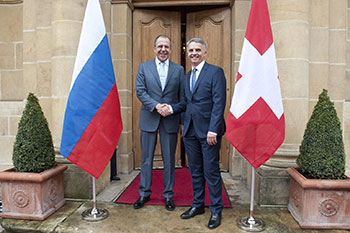
Russian Foreign Minister Sergey Lavrov said Russia’s first priority is to end the violence in Syria as fast as possible to avoid more civilian deaths and to search for a final settlement for the future of national reconciliation.
Lavrov’s remarks came after meeting Swiss Foreign Minister Didier Burkhalter Friday in
Neuchatel, Switzerland ,according to the AP.
On N.Korea, Lavrov supported renewed talks in Geneva, if Pyongyang were to agree to hold discussions with Russia, Japan, South Korea, the United States and China.
But both officials made clear there was no such general agreement.
“If we can re-establish that, Russia would, of course, support it,” Lavrov, who spoke in Russian, said in response to a question.
North Korea agreed in principle in 2005 to scrap its nuclear program, including a presumed small stockpile of weapons, in return for aid and diplomatic incentives from other members of the six-party talks. But Pyongyang walked out of talks in 2009 and later conducted more nuclear tests.
Recently, North Korea warned it has weapons “on standby” and aimed at its foes if provoked, but has not revealed specific plans to fire a missile or carry out another nuclear test.
Swiss Foreign Minister Didier Burkhalter, who spoke in French, said his nation had offered to host such talks “but, of course, that should be agreed by all parties and that is not the case at the moment.”
Lavrov also warned the United State against naming Russians accused of human rights abuses, who are to be targeted for U.S. financial sanctions and visa bans under a new law dubbed the Magnitsky Act. The law was named for Russian lawyer Sergei Magnitsky, who was arrested in 2008 for tax evasion after accusing Russian police officials of stealing $230 million in tax rebates.
Lavrov hinted that Russia has its own list of U.S. officials that would be similarly sanctioned and would release those names in retaliation, along with using the so-called Magnitsky List to possibly block future cooperation on security issues.
“Of course, Moscow will react and our American partners know about that very well,” he told reporters. “And given the circumstances, I don’t think they’ve chosen very good timing, since the American national security adviser is coming to Moscow to bring President Obama’s message with his vision for the prospects of our broader cooperation.”
M.D