
Dr. Ghabash: The necessity of supporting Syria to achieve the goals of sustainable development
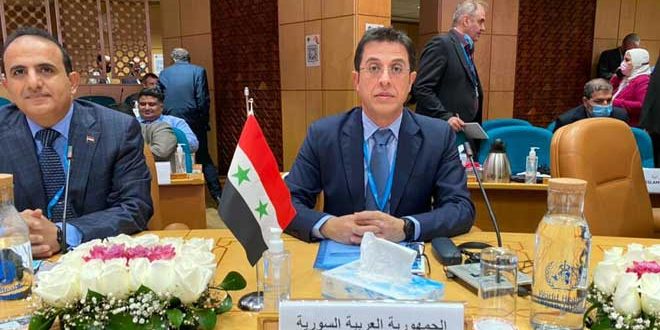
Health Minister Dr. Hassan Al-Ghabash stressed the need to support Syria’s march in achieving sustainable development goals, stopping aggression and terrorism against it, lifting unilateral coercive economic measures, and contributing to the reconstruction of what was destroyed by the terrorist war.
In a statement on sustainable development presented during the 69th session of the WHO Regional Committee for the Eastern Mediterranean currently being held in Cairo, Minister Ghabash said that Syria participated in the United Nations summit in which the 2030 Agenda for Sustainable Development was adopted, based on its belief in the importance of international cooperation to advance development, prosperity, and commitment to the international consensus on these goals. He said: During the past millennium, Syria achieved good and stable growth rates, implemented ambitious plans for reform in line with the available capabilities, and also achieved successes in human development, especially health, education, housing services and empowering women, pointing out that this is what made Syria one of the countries that were previously classified as moving on the way towards achieving the sustainable development goals.
Dr. Al-Ghabash pointed out that the situation changed radically after 2011, when the terrorist war on Syria led to a large number of health facilities and human resources being out of service, and weakening the population’s access to health services.
Dr. Ghabash pointed out the impact of the war on children in Syria psychologically, physically, socially, health and living conditions, and the exacerbation of the problem of balanced geographical distribution of the population, as a result of large population displacements between governorates which led to a high population density in areas at the expense of other areas, leading to a great pressure on services and infrastructure.
The Minister indicated that despite the repercussions of the terrorist war, the restoration of health services was accelerated with the concert of local and international efforts, and there was a slight improvement in some indicators, pointing out that the challenges facing achieving sustainable development are multiple in Syria, in terms of their sources and their nature between external, internal, structural, contingent, objective and subjective.
Dr. Al-Ghabash pointed out that some of these challenges are more important than others in terms of the direct impact, and in terms of their multiplier effect, from the challenges of peace and security in regions to the continuation of the Israeli occupation of part of the Syrian land, and the accompanying difficult economic and social living conditions, to the continuation of coercive measures due to the unilateralism imposed on Syria, and the economic effects the sanctions caused, reflected on all aspects.
Today concludes the work of the 69th session of the WHO Regional Committee for the Eastern Mediterranean, with the participation of Syria, which began on October 10 in Cairo under the slogan “Together for a sustainable tomorrow and better health.”
NR