
Diplomats used to take Damascene wooden mosaic as souvenirs from Syria
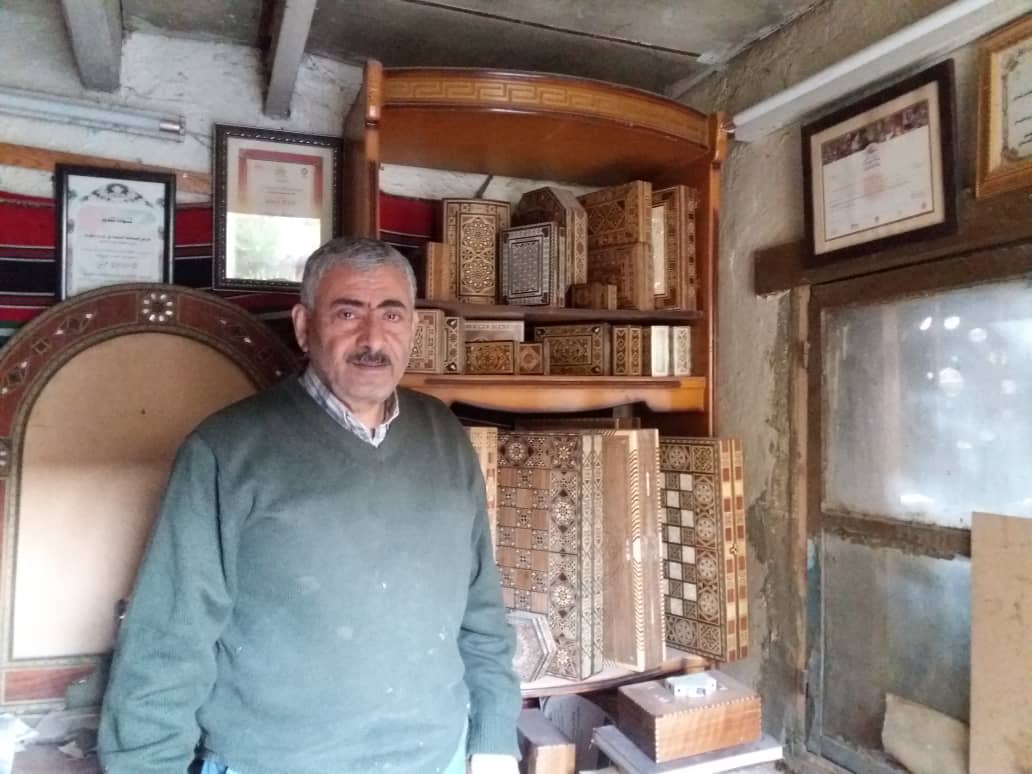
Arab and foreign visitors, especially diplomats, who were resident in Syria used to take Damascene mosaic products as a souvenir that reflects the beauty of Damascus.
These mosaic products are confined to the heritage of Damascus only, and the way of producing them is not circulated in other countries in the world, according to head of oriental craft professions association in Damascus, Mr. Fouad Arbash, who started his work in his mosaic workshop since 1979.
Mr. Arbash told Syria Times: “There were attempts to transfer this craft to other countries, but they failed… The only similar craft exists in Iran and it is called “ Khatam” but it uses only black wood and bone.”
He clarified that reason behind the failure of transferring this craft to other countries is the fact that the raw material that is wanted to produce wooden mosaic products is available in Syria, to be more accurate in the Ghouta of Damascus where there are several types of woods such as walnut, lemon, olive eucalyptus….etc. “Each type of wood has a colour that differs from the other one and this is important in the decoration of mosaic pieces… The colour of mosaic products does change because the natural colour of wood is used.”
This craft witnesses a sharp decline in the number of workshops due to the current circumstances that the country is going through.
“There was a workshop in each alley in the old city of Damascus…. There were thousands of workshops, while the number of workshops now declined to scores. Moreover, many workshops transferred from Damascus to Damascus countryside (Erbin, Jobar, Jaramana, Zamalka, Biet Sahem areas) after the residents of these areas had learned in Damascus how to make wooden mosaic pieces,” Mr. Arbash said.
He indicated that mosaic workshops in the old city of Damascus had turned into antique shops, or restaurants or other places.
Mr. Arbash is now working alone in his workshop.
“I am working alone in the workshop as the workers travelled abroad, or were displaced and moved to other professions due to the circumstances that the country is going through. The mechanism of work is based on producing every hundred pieces together to save time as the production of one piece takes a long time. Such a craft requires physical and intellectual efforts, at least 2 years of training and patience.. The old generation had the ability to be creative in this craft, while the new generation is not,” he declared.
 The oriental craft professions association is exerting every possible effort to keep this craft alive through participation in international exhibitions and holding free training courses to youths.
“All neighboring countries and some European countries, especially France, were importing mosaic products from Syria… We were receiving orders from tourists, but now there are no tourists… The exportation reduced 90%… We are now making mosaic pieces to show them in Beirut,” Mr. Abrash clarified.
He gave us the following information about the history of this craft.
“In 1860, local Damascene artisan Gergy Al-Bitar, who was 29-years old then, made the first wooden mosaic piece by collecting strips of naturally colored wood of triangular or square cross-section, then cutting them in the form of chips and gluing them to the wooden crafts with natural glue.”
“Al-Bittar was awarded by the Ottoman sultan for an exquisite wooden mosaic furniture which he made. He worked on making the mosaic products known at international levels through his participation in Vienna exhibition in 1891 and Paris exhibition where he decorated the Church of St. Julian the Poor. He also won the first prize for wooden works in Egypt in 1904, and he made a wardrobe for Pope Pius X. In addition, Jimmy Carter, the former US President took a number of pieces of Damascus mosaic to the White House.”
Each mosaic piece shows the professionalism of artisan.
Interviewed by: Basma Qaddour