
Damascene paint
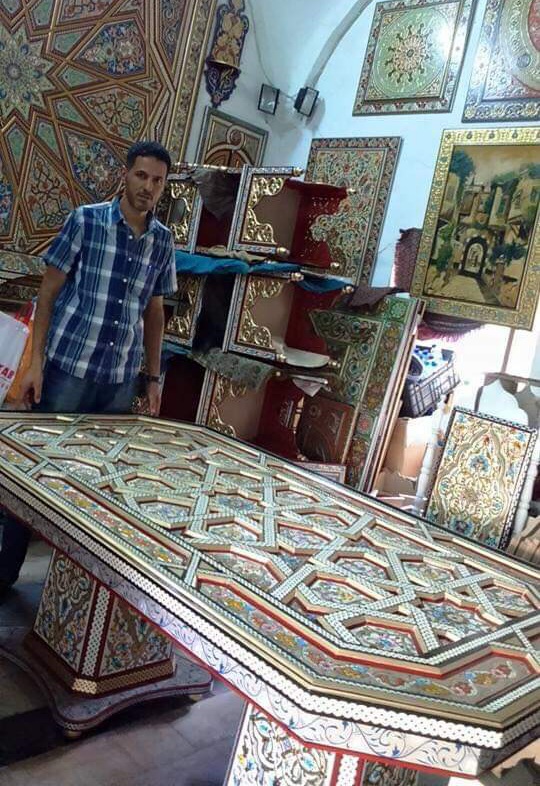
Damascene paint is an ancient craft that dates back to 1400 years ago – during the Umayyad period, and it emerged due to the connection between art and politics at that time.
This craft has many names: Ajami drawing, botanical or geometric drawing on wood, Damascene paint, Arabesque and the art of Attawriq due to its antiquity, according to Eng. Arafat Otabashi, who inherited this craft from his grandfather.
Eng. Otabashi told Syria Times: “Painting on wood came from previous civilizations and it was called Ajami during the past period due to its connection with Persian motifs despite the fact that it came originally from Damascus…It crystallized and took a new direction with a Damascene pattern and so was called Damascene paint . The name Arabesque and Attawriq means geometric design and style…. Painting on wood is a decorative work that has philosophical meanings.”
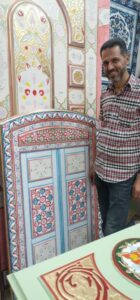 He added: “The first work of this craft was done in Al-Quds city [Jerusalem] and then it moved to Damascus where the Umayyad Mosque embraced the first paintings of this craft to spread later in most Damascene houses…Professional craftsmen in Damascus used to practice three types of drawing: botanical drawing, geometric drawing and calligraphy drawing.”
Eng. Otabashi indicated that several families such as Otabadhi [AKA Al-Dahhan] and Al-Shami practiced this craft in Syria and Lebanon in the past and they still pass it on to the younger generation.
“The late craftsman Mohammad Adib Otabashi preserved this craft, and he was honored by the Ministry of Tourism during the 3rd conference of Preserving Intangible Heritage in Syria,” he added, referring to the fact that the number of craftsmen has sharply declined nowadays.
Eng. Otabashi clarified that the craft flourished in Damascus during the Ottoman period , and it was mainly used in decorating palaces. “This craft has a special character in each period as there are Umayyad and Abbasi patterns with different colours.”
Damascene paint’s craftsman draws the pattern first and then he colors it using either warm or cold colors. The oriental colors in Damascus are cold, such as purple, green and orange. However, the warm colours, such as yellow, are used in hot areas such as the desert.
The wonderful colors and patterns of this art decorate the walls and ceilings in a beautiful manual panoramic way. So large halls and salons used this decorative art, and perhaps the most famous and oldest of them that still exists from hundreds of years ago is the “Damascus Hall”, which was moved from one of the historical Damascene palaces to the Damascus National Museum.
Interviewed by: Basma Qaddour