
Damascene brocade … the imprint of Syrian silk to the world
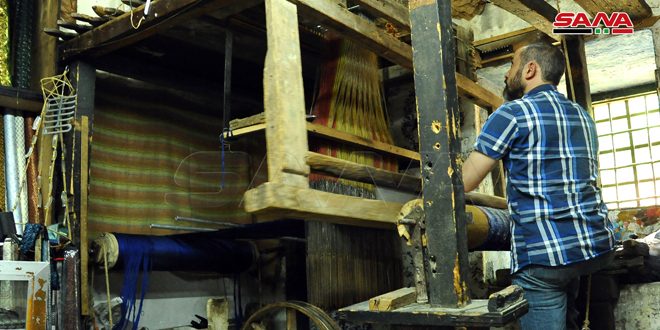
The Damascene brocade is the most famous and finest of fabrics and textiles in the world. Brocade industry is an accurate and exhausting process that requires high efforts. The art of weaving this beautiful fabric has flourished in Damascus for many decades as brocade became connected with Damascus internationally .
Damascene unique brocade is a rich shuttle-woven fabric and one of the most famous, luxurious and most expensive types of textiles because it is made of gold, silver and natural silk threads.
 Researcher Ghassan Kallas told SANA that the fame of the Damascene brocade fabric by skilled professional and specialists has spread over continents and it was required by kings , queens, rulers and celebrities. It reached the royal palace in Buckingham, Britain, when Queen Elizabeth II had her wedding dress in 1947 made of brocade embroidered with gold and silver.
Kallas pointed out that the brocade fabric amazed art lovers around the world with its lightness and delicacy as he met one of them in Poland, who boasted in front of him about his house’s curtains which were made of brocade .
The researcher highlighted that the fabric of brocade is characterized by being soft to the touch, resistant and fine and therefore difficult to be weaved on automatic loom machines that do not achieve the accuracy and coloration offered by the manual shuttle.
Damascene brocade fabric is composed ,according to Kallas , of natural silk threads brought from the villages of the Syrian coast, especially “Draikish” region, in addition to fine threads of gold and silver which are combined with each other by Damascene craftsmen to form various drawings of birds, deer and dancers after long hours of work behind the loom to make one meter pattern.
Regarding the varieties and decorations of brocade , Kallas explained that it has different types according to different elements used with silk , indicating various colors of brocade fabric patterns are related to tastes which differ from one country to another starting from two colors till seven in one piece of brocade.
 The researcher underlined that the looms of the Damascene textile industry were located mainly in the neighborhoods of “Al-Qaymariya”, “Shagour” and “Rukn Eddin”, as well as some towns in the Damascus countryside, where they managed to confront the invasion of European textile manufactures at the beginning of the twentieth century .
He underscored that Damascene brocade textiles witnessed local, Arab and international turn-out especially by foreign tourists who visit Damascus constantly.
On the mechanism of weaving brocade and its techniques, Kallas explained that it begins by placing silk paralysis on a machine called kebabah ( spool) , turning it into strings on wooden reels, then these reels are taken and placed in a second machine which collects the strings from two or more spools on one reel so that the strings turn into double, triple or a quadruple to be then placed on a twisting machine, which spins these threads together to form one strong, twisted thread, but their number varies according to the type of fabric required.
 Kallas referred to some vocabulary words and terms related to this craft from the weaver who weaves the yarn, silk, wool or linen and the machines and pieces that he uses in the weaving process, some of which are derived from the inherited Damascene dialect, such as loom, stitching, folding, zircon , shuttle, comb, stomping , coatings, the crossbows , the reels and spools.
The researcher concluded by stressing that brocade is an essential part of the ancient industries of Damascus, which has achieved a distinctive and unique identity and preserving it is in the interest of preserving our civilized identity and our ancient culture.
Rawaa Ghanam