
Cultivation of vine leaves in Lattakia countryside … a supportive crop that brings economic returns to farmers
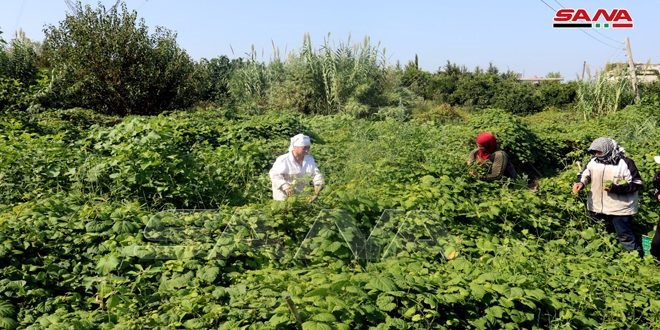
Cultivation of French grapes “vine leaves”, a modern crop in Lattakia countryside, has surpassed the cultivation of local grapes recently, due to their resistance to diseases, climatic changes and their good financial returns and easy marketing.
During a tour by SANA’s correspondent in one of the farms specialised in cultivating this type of grapes in “Fadra” area in al-Bahluliya village, farmer Ali Mannaa said that he allocated large areas of his farm to cultivate and produce French vine. He got irrigation water from the Mashqita and Tishreen Dams, as this crop needs a huge quantity of water, he added, pointing out that there is a great demand for the cultivation of this kind of grapes, as it provided job opportunities for locals during the stages of harvesting, packaging and marketing the vine leaves.
 For his part, the agricultural engineer Bassam Haddad said in a statement to SANA that French vine does not produce fruits and unlike the local vine, it is not affected by diseases or climatic conditions such as cold and rain. Plus, it does not need large quantities of pesticides and its cultivation flourished as a support crop, indicating that the production of vine leaves starts in April and reaches its peak in July and August, while the process of picking the leaves continues until October.
Talal Ajeeb, head of the municipality of Fadra, stated that the villages and farms of al-Bahluliya have been famous since ancient times for cultivating olives and citrus fruits, and as a result of fertility of the soil and the availability of irrigation water, the cultivation of vine leaves has spread, occupying about 25 percent of the agricultural land area. He noted that 15 percent of the population depends on this crop for their income.
Eng. Nagwan Ghazal, from “the Department of Plant Production in Lattakia Agriculture”, said that cultivating French vine leaves is a new sort of cultivation with good revenues to farmers, but until now it is not adopted in the state-run agricultural centers.
 The area cultivated with vine leaves in al-Bahluliya amounts to about 150 hectares and the number of trees reached 150,000, Ghazal said, noting that the vine leaves production was estimated at 3000 tons. He indicated that the care accorded to vine leaves is confined to pruning, irrigation and fertilizers in addition to combating insect diseases that may affect the crop.
Stuffed vine leaves, (Arish leaves or yabruq in Arabic) is a popular dish in the Middle East and it is a main in Syrian cuisine, especially because of its delicious taste and high nutritional value.
Lama Razzouq