
Copper Industry in Syria Dates Back to Ancient Times
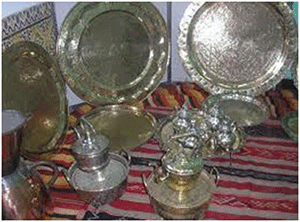
DAMASCUS, (ST) – Syria remains an ancient land that has enjoyed involvement and interaction with many different civilizations over the last ten thousand years.Syria’s historical importance and its crucial location at the crossroads of several ancient trading routes mean that a wide variety of crafts have developed.
In the city of Aleppo there are markets dedicated to protecting hand- made copper goods, to ensure that this ancient craft doesn’t vanish. Copper artifacts have been discovered all over the region. Some of these artifacts date to the Bronze age around 3000 BCE. Historians have identified a number of uses for the material including weaponry, jewelry and ornaments. These items give us information about the way ancient peoples lived and interacted.
Craftsmen Union in the city is trying to revive this world- famous industry by establishing a training center and promoting the local and regional trade of copper products. There are several processes involved in the production of copper goods, including cutting, welding and ornamentation. The metal then has to be thoroughly cleaned before it is suitable for sale.
Currently, only a small handful of artisans continue to practice this craft. However, local people are being encouraged to learn the skills needed to make ornate copper items which will be suitable for commercial sale.
Copper industry, is one of the leading features that, has distinguished Damascus since ancient times as large international museums include many copper pieces such as pitchers, dishes, cups censers, candlesticks and chandeliers.To make these things, the Syrian craftsman used various types of available metal foils with various creative methods such as carving, pressure, hammering, inlaying, and plating.
Inscribing on the metal is to cut or scratch decorative lines either using the hammer and sharp pointed tool or a small pen designed for digging or by using acid on the surface of the metal to be decorated as diluted nitric is used and the surface of the metal is covered with wax and then the drawing lines will be determined by a thin metal pen until the substance reaches into the metal surface which is eroding an the depth of digging depends on the duration of leaving the acid over the surface of the metal and this process is called freckling (tanmish).
Hammering the metal is a kind of artistic works implemented on copper such as trays and vases. The cooper items are pounded with a hammer and special chisels, in conformity with designed drawings that represent Islamic, Roman, Christian and Persian historic stories including geometric shapes and writings of Quranic verses and this type of works is implemented on red copper being soft.
Plating (Al Takfit) is installing wires or metal foils of gold or silver on the surface of another metal by digging drawings with a solid sharp pointed tool, then these cooper items are ornamented with gold or silver wires by light hammering.
The artisan, Ahmad Rateb AlDa’nei confirmed that he makes, in his workshop located in the area of Bab Sharki , Eastern lanterns, chandeliers and Arabic coffee pots and decorates them with plant- shaped drawings. He sells his products in the local market and some are exported to Gulf countries and Europe.
In the Mamluk era, metal curiosities carried the features that distinguish that era. New decorative expressions were added to the traditional plant decorations. What was commonly used is a drawing to a pair of birds in arranged positions added inside rhombics as seen on a pitcher in the Metropolitan Museum in New York, which bears the name of King al-Nasir Muhammad bin Qalawun.
It was also widely used flying ducks about official badges which include titles and the names of Mamluk sultans and what reflects this work is a pitcher to Mohammad Al –Khazindar. In Metropolitan Museum, there are four pieces represent the Damascene industry and its superior splendor in this art. The pieces are pen case, two censers, and a bowl and each one of the pieces is rich with silver and gold.
The style shows its history at the end of the thirteenth century or the beginning of the fourteenth century, while the pen case is considered as one of the best-known examples and masterpieces produced by Mamluk industry. It is plated with gold and silver and adorned with drawings from inside and out.
The most famous pieces of this group are called baptism basin of St. Louis that is kept at Allover Museum in Paris, which was made by Mohammed bin Al- Zein.The basin is rich in animal and human figures.
Copper pots with human figures like the products produced by the factories of Aleppo and Damascus of glass coated with enamel. These products can be attributed to the makers of Syria at the end of the thirteenth century and the beginning of the fourth century.
The production of Egypt and Syria of Mamluk metal objects kept up a large degree of perfection during the fourteenth century and then methods of floral expressions continued especially at the end of that era and we can see an evidence of this in several pieces at the Metropolitan Museum.
Sh. Kh