
Chameleon’s tongue gives up secrets
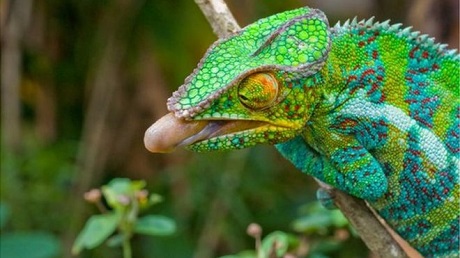
Scientists have built a mathematical model to explain the secrets of the chameleon’s extraordinary tongue.
It took more than 20 equations to capture mathematically how the reptile’s tongue unravels at very high speed to snare insects, according to BBC.
The model explains the mechanics of the animal’s tongue and the inherent energy build-up and rapid release.
British researchers say the insights will be useful in biomimetics – copying from nature in engineering and design.
“If you are looking at the equations they might look complex but at the heart of all of this is Newton’s Second Law – the sort of thing that kids are learning in A-Levels, which is simply that you’re balancing forces with accelerations,” explained Derek Moulton, associate professor of mathematical biology at Oxford University.
He added: “In mathematical terms, what we’ve done is we’ve used the theory of non linear elasticity and captured the energy in these various tongue layers and then passed that potential energy to a model of kinetic energy for the tongue dynamics.”
The chameleon is a reptile with many distinctive features.
Its feet have two toes facing forward and two facing backwards, like a bird; it can grasp objects with its tail; it can change colour and its tongue is among the fastest on Earth.
The chameleon’s tongue is able to extend to twice the length of the body while unravelling telescopically.
Past research has shown if the tongue were a car, it could accelerate from 0 to 60 mph in one hundredth of a second.
A team led by the University of Oxford used observations and experiments to develop a mathematical model to explain this feat.
Part of the secret of the chameleon’s success, the researchers confirmed, is special stretchy tissue in their tongue.
At the core of the tongue is a bone, which is surrounded by 10-15 layers of very thin fibrous tissues, then a muscle.
“The equations are modelling the mechanics of these different layers, and the interactions of these different layers,” Dr Moulton explained.
“The balance of forces and the energy contained in these different layers when the muscle – this outermost layer – contracts, which is what sets the whole thing in motion.”
H.Z