
Busan Temple, an archaeological monument in Sweida, dating back two thousand years
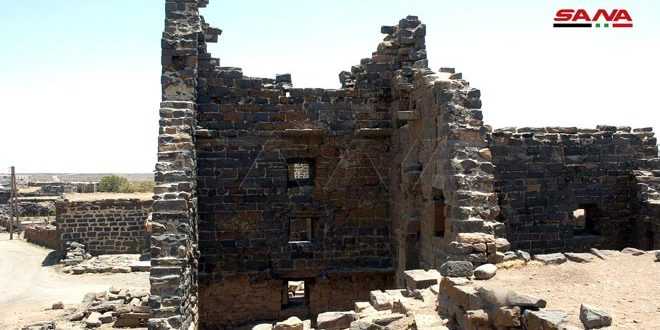
Sweida (ST): The archaeological temple in the village of Busan, located in the eastern countryside of Sweida is one of the most important archaeological monuments in the village, which has had successive civilizations and peoples pass through it from the Nabataean period through the Roman and Byzantine eras up to the Islamic era and left their traces in every corner of it.
The head of the Sweida Antiquities Department, Dr. Nasha’at Kiwan, referred to the historical importance of the Busan Temple, which was built in the Roman era about two thousand years ago, pointing out that the building in its square has a basilica plan that is likely to be a church and a house dating back to the post-Byzantine period.
Kiwan indicated that this temple was built of basalt stones, and it formed the incentive for the Sweida Antiquities Department to carry out restoration work with the aim of preserving its historical value, noting that historical documents talk about the existence of about 800 houses in the village at the end of the Roman period.
Kiwan added that the village is distinguished for its beautiful stone architectural texture and its ancient buildings constructed of basalt stone referring to the spread of Arabic writings and inscriptions on the buildings dating back to the Ayyubid and Mamluke periods.
Kiwan pointed to the richness of Busan village with its monuments, the most prominent of which are ancient towers dating back to the Roman era, the archaeological tower of Busan, which dates back to the Byzantine period, and important archaeological houses including traces of two palaces, one of which is the Palace of the Prophet Job, which is one of the most important monuments in Busan, which consists of several floors. The towers were built of basalt stone and roofed with basalt carried on arches.
The village of Busan is a beautiful tourist site enjoying a moderate climate in summer but is very cold in winter, as it is located on a high volcanic mass that extends to the mountainous region and is about 20 km from the city of Sweida.It rises 1500 meters above sea level.
K.Q.