
Bird family tree shaken by discovery of feathered fossil
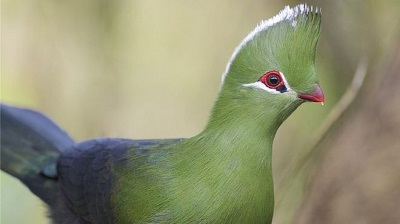
They’re some of the strangest birds in the world, known for their bright plumage and their penchant for fruit.
The turacos, or banana-eaters, are today found only in Africa, living in forests and savannah, according to BBC.
A beautifully preserved fossil bird from 52 million years ago is shaking up the family tree of the exotic birds.
The fossil’s weird features suggests it is the earliest known living relative not just of the turacos, but of cuckoos and bustards (large long-legged birds).
And the fact the remains were unearthed in North America shows the distribution of different birds around the globe would have been very different in the past.
“Our analyses show with some strong support that the fossil is the earliest known representative of this group, the turacos, or the banana-eaters, that today are only found in sub-Saharan Africa,” said Dr Daniel Field, a vertebrate palaeontologist in the Milner Centre for Evolution at the University of Bath.
“Although, our fossil comes from western North America and it’s about 52 million years old.”
 The attractive and colourful turacos of Africa are noisy, gregarious birds. They feed mostly on fruits and enjoy bananas, as their name suggests.
Dr Field said these fascinating birds, which he has photographed all over Africa, are a group well known to bird watchers.
“They’re extremely gaudy, very colourful, and their feathers contain unique pigments that produce brilliant greens and red tones that are present in no other groups of living birds,” he told BBC News.
Dr Field and Allison Hsiang of the Swedish Museum of Natural History decided to take a closer look at the fossil bird (Foro Panarium), in the light of new knowledge about bird evolution.
The fossil, originally dug up in 1982 in Wyoming, has a mixture of features that are shared by different groups of living birds.
They were surprised to find the fossil bird was an ancient relative of the turaco, but found miles away from its living descendants.
This raises questions about how, when, and why the birds became restricted to tropical latitudes.
Dr Field said there are over 11,000 living species of bird today, and trying to understand how this incredible diversity is only possible “by appealing to what the fossil record tells us about how those evolutionary transitions have taken place”.
H.Z