
Between originality and development, Oud making is a journey inherited from grandparents to grandchildren
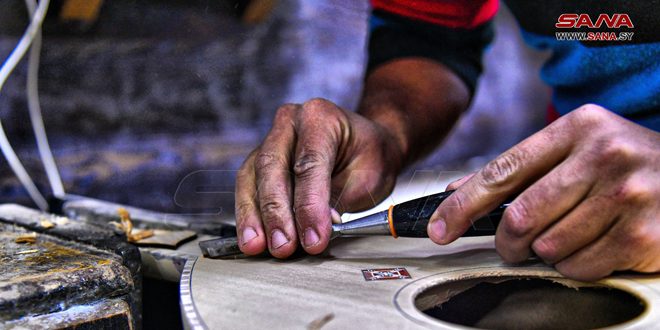
Damascus (ST): From the heart of the capital, Damascus, features of a great determination to preserve the essence of the Syrian cultural heritage and adhere to the identity of one of its components, which is (the Damascene oud) are evident.
Walking through old Damascus, you are captivated by the Oud-making workshop (Ziryab) of its young owner, Ali Khalifa, who inherited it from his grandfather and is still innovating and adding to the secret of the profession (accuracy and craftsmanship), preserving the identity of the Damascene oud and preserving the name of his grandfather in the field of making this ancient oriental instrument.
The young man in his thirties recounts his beginnings in the world of oud, saying: “My late grandfather, Ali Khalifa, learned from the famous craftsman Bedrosian and a group of ancient oud makers, and in 1948 he moved to his own workshop, with which the family’s journey with the oud industry began, to constitute the distinguishing mark in terms of production to cover the needs of the market and the increasing demand to buy oud.”
The grandfather developed the manufacture of the Damascene instrument, preserving the heritage value marked by the ancient Syrian character within the unchanging and unmodified molds until the nineties of the last century, which earned it a distinguished reputation at the regional and international levels, and it was acquired by many Syrian and Arab oud players, including musicians Farid al-Atrash, Muhammad Abdel-Wahhab, and one of the lutes is located in Umm Kulthum Museum in Egypt.
Ali continued what his grandfather started with great skill and added to it his spirit and experience, and named his workshop (Ziryab). He pointed out that he developed the oud to keep pace with modernity in music, so these details had a noticeable role that contributed to his success to become one of the most famous oud makers locally and in the Arab world.
About the stages of manufacturing the oud, Ali says: “The wood comes in large pieces and we often use walnut wood, and we cut it in the form of ribs by making its sides equal so that the left side matches the right,” indicating that he treats the wood to resist weather factors and has a sound and consistent shape according to physical rules and equations. Then it works to shape the rest of its parts such as the neck and the house of the keys, all the way to connecting the back and the face, and at each stage it is necessary to give the oud a period to rest and take its final shape, so that we can finally get a masterpiece.
K.Q.