
Benefiting from partnerships and modern technology in managing the risks facing Syrian heritage
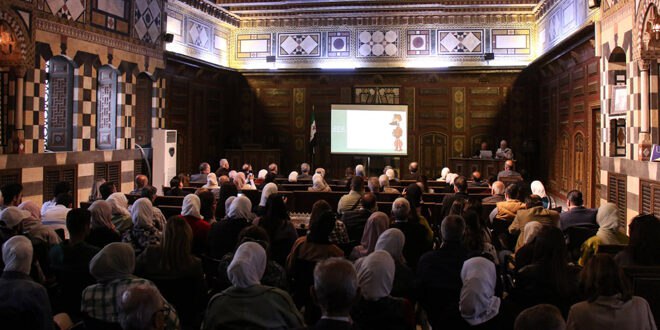
In the light of the challenges facing the Syrian cultural heritage and the efforts to confront these challenges in order to preserve civilizational identity, the National Museum in Damascus hosted a scientific seminar organized by Economus Syrian organization, under the auspices of the General Directorate of Antiquities and Museums.
The seminar, entitled “Enhancing Partnership in risk management and protection of heritage”, began with an opening session led by the Deputy President of Economus Syria, Engineer Kheir Al-Din Al-Rifai, who noted that the heritage of Syria, as the birthplace of the first human civilizations, requires a comprehensive vision that preserves its authenticity and keeps
pace with contemporary demands.
This vision should consolidate the efforts of official institutions, civil society, academic institutions, and specialized organizations, working towards a participatory approach that achieves sustainable development for preserving heritage as an economic and cultural resource.
Community Partnership in Heritage Preservation
President of “Syrians For Heritage” Association Khaled Al-Fahham discussed the importance of developing comprehensive national strategy to preserve architectural heritage based on real partnership among all stakeholders, including governmental institutions and civil organization and local communities.
Al-Fahham emphasized the significance of preserving the traditional irrigation system in
Damascus as a model of interaction between cultural and environmental heritage, pointing out that the historical Barada irrigation channels represent a unique engineering system for managing water resources.
Artificial Intelligence in Service of Heritage
Researcher Sundus Omar Hamidi, a member of Economus Syria, spoke about managing risks threatening heritage using Artificial Intelligence, through digitization, archiving faded texts, and restoring them automatically.
She highlighted virtual museums that provide VR tours for visiting archaeological sites and predicting risks through data analysis, in addition to automated visual inspection to accurately detect defects in heritage buildings.
She also explained that artificial intelligence could contribute to developing early warning systems to protect archaeological sites, creating three-dimensional digital models of heritage sites, and developing precise restoration solutions using modern technologies.
Souha Suleiman