
At least 111 deaths, 516 injuries in Aleppo, Hama, and Lattakia as a result of 7,7 magnitude earthquake that hit north of Liwa Iskenderun
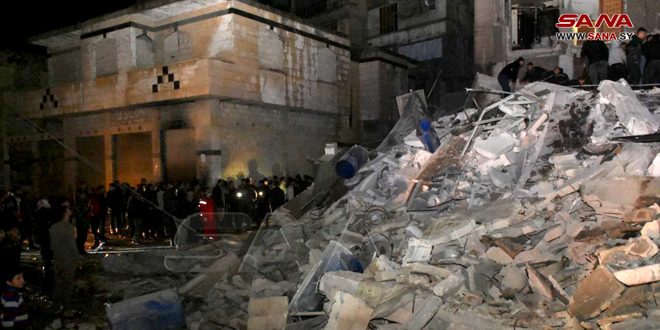
At least 111 people died, 516 others were injured in the Syrian provinces of Aleppo, Hama, and Lattakia in an non-final toll, as a result of the 7,7 magnitude earthquake that hit north of Liwa Iskenderun (Alexandretta) this dawn, according to the Syrian Health Ministry.

Director of the Earthquake Center: All aftershocks are of weaker intensity
The Director General of the National Center for Seismology, Dr. Raed Ahmed, explained that Syria was affected by the earthquake that occurred in the north of Liwa Iskenderun (Alexandretta). The areas that are close to the epicenter in Hama, Idlib Lattakia and Aleppo were most affected.
Dr. Ahmed stated in a statement that the aftershocks have occurred and will occur successively, but they are much weaker than the main earthquake that occurred, indicating that citizens who left their homes on the roads can return to their homes if they are not cracked because all subsequent aftershocks are weaker in intensity.
Tsunami is not expected
He indicated that the earthquake and aftershocks have occurred on land, and did not occur at sea, so a “tsunami” is not expected.
Dr. Ahmed pointed out that this earthquake is the strongest during the work life of the national seismic monitoring network, i.e. since 1995, explaining that the state of seismic instability will continue, but with tremors of weaker impact and within the limits of (5) degrees.
Dr. Ahmed pointed out that several buildings, which have weak resistance to earthquakes, were damaged and collapsed.
Later, the National Center for Seismology announced that a 4.6 magnitude aftershock occurred in Liwa Iskenderun at 8.36 a.m.
Citizens in Aleppo, Latakia and Homs felt this aftershock, the center said.
A 7.7-magnitude earthquake hit north of Liwa Iskenderun region this dawn followed by another 6.4-magnitude earthquake in the Taurus region on the Syrian-Turkish border, and a number of weaker aftershocks. Several Syrian governorates were affected by them, and a number of buildings were damaged as a result.
K.Q.