
Ancient Syrian sites are in peril !
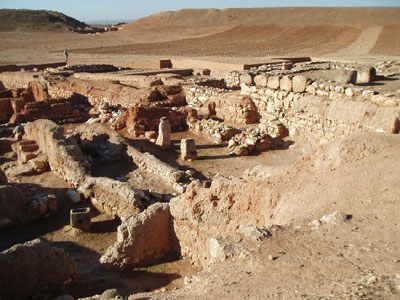
According to a recent article by the New York Times, Ancient Syrian sites are in peril. Indeed they are; hence a terrorist who doesn’t value the human life can in no way value the heritage and history of his own country.
The daily added that an opposition fighter, Shibleh, – terrorist- and beneath Ebla, an ancient ruin that for several decades has been one of Syria’s most carefully studied and publicly celebrated archaeological sites, has just made another of his many finds; he lifts something resembling a dried stick, then squeezes it between his fingers and thumb. It breaks with a powdery snap. ”This is human bone,” he says.
Across much of Syria, the country’s archaeological heritage is imperiled by war, facing threats ranging from outright destruction by bombs and bullets to opportunistic digging by treasure hunters who take advantage of the power vacuum to prowl the country with spades and shovels.
Ebla is a mound rising above the Idlib plain. It was first settled more than 5000 years ago. It eventually became a fortified walled city whose residents traded olive oil and beer across Mesopotamia. The city was destroyed around 2200BC, flourished anew several centuries later and then was destroyed again. the presence of terrorists in Ebla has brought harm. Ebla, occupied by a few ”rebels”, is suffering the effects of more traffic, damage and theft.
Shibleh digs on the ancient mound, and he has explored its underground passages. ”It is another country underground,” he says, crawling through tunnels he clearly knows well. In one section of tunnel, Shibleh finds a large scoop-shaped piece of bone that appears to be as light as a wafer. It had been part of a human head. ”There were too many skulls,” he says. ”The cave here was full of them.” Those skulls, he says, are now gone – removed by artifact hunters and then thrown away.
Grave sites are potential spots to find jewellery or figurines interred with corpses. This has made Ebla, like hundreds of other sites, a tempting spot for thieves.
In the 1960s and 1970s Ebla became well known among archaeologists when a mission led by the renowned Italian Professor , Paolo Matthiae, of La Sapienza , Rome 1, University, discovered the city-state’s long-buried archive of more than 16,000 stone tablets. As they have been translated from cuneiform script, these records have shed light on life in a city from another time.
”Ebla was the most important and prominent kingdom in the era of 3000 BC,” says Cheikhmous Ali, a Syrian archaeologist and an organizer of Protect Syrian Archaeology, an association that has been documenting damage and theft of antiquities.
The meticulous excavation of Ebla’s ruins had continued in the decades since the tablets were unearthed, but archaeologists had left much of the site undisturbed, for careful sifting by future teams. That methodical examination has recently been replaced by crude digging and crime. Shibleh says some people also come to the site and haul away carloads of dirt from inside the tunnels; it is ideal, he says, for making the ceramic liner for bread-baking ovens. ”This is vandalism,” he says. ”Destroying the site by throwing the skeletons haphazardly here and there.” ”A whole civilization belonging to all humanity is being destroyed,” Ali says.
Dr. Mohammad Abdo Al-Ibrahim