
An audio-visual device for the blind invented by Syrian students
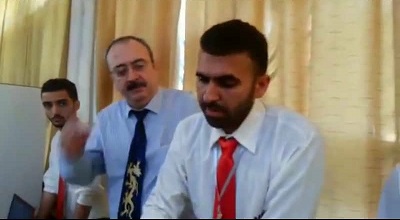
Supervised by Dr. Carlo Makdisi, Eng. Ziad Hammoud and Amjad Hassan, who are students at the Faculty of Mechanical and Electrical Engineering in Tishreen University in Lattakia Governorate, design an advanced ultrasonic device for the blind as to help them overcome obstacles.
The device was presented for the first time at the” Applied Projects Exhibition”, which has been recently held at the Faculty of Mechanical and Electrical Engineering in Tishreen University in Lattakia.
To know more about this invention, the Syria Times e-newspaper met Dr. Makdisi, who said: “The idea of the project is based on ultrasound circuit connected to a programmable microcontroller to form an integrated device that does not exceed 15 cm long. In addition to an audio set connected to a device placed with the ear of the blind. The earpiece emits sounds in different ways, warning that there are people or objects passing by the blind side.
 The blind can hold the device in his hand to detect or feel the presence of people or objects at a distance of 4 meters so as to prevent the blind to collide with people, cars, moving and fixed objects.”
“The device is rechargeable via dry battery or solar cell. It is equipped with an external charger attached to the device with an audible alert that warns the blind when the charge level drops below 30%. It has also the possibility of reprogramming according to the requirements of the blind.”
Dr. Makdisi clarified that the cost of this device does not exceed 15,000 SP stressing that it is cheaper than all the devices in the market that perform the same function.”
“This device has been implemented by Syrian students at their own expense without any financial support. Personally I supervised the ideas, designs and everything related to the work as a service to every Syrian blind person.
We proudly say that our device is a new achievement to be registered in the name of Syria despite all the circumstances surrounding the work and the economic sanctions imposed on our beloved country”, Dr. Makdisi concluded.
Interviewed by Amal Farhat