
Ambassador Shakur: The unilateral coercive economic measures against Syria violate international conventions
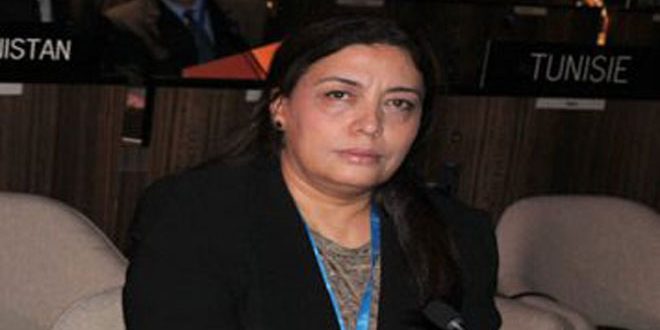
Ambassador Lamia Shakour, the permanent representative of the Syrian Arab Republic to the United Nations Educational, Scientific and Cultural Organization (UNESCO) affirmed that the unilateral coercive and unfair economic measures imposed on the Syrian people violate international conventions and the provisions of international law. She noted that the Syrian government is making tremendous efforts to ensure the continuation of the educational processes and to preserve Syrian cultural and natural heritage.
In a speech during the opening session of the Executive Council of UNESCO, Shakour referred to the increased suffering of the peoples and countries due to the unilateral unfair sanctions imposed and renewed by various pretexts.”
Shakour added: “The takfiri armed terrorism, unfair sieges and epidemics target the capabilities of peoples, the sustainability of their societies, the future of their generations as well as the cultural property.” She condemned the international community’s disregard of the continuing occupation’s illegal presence and blatant external interference in the internal affairs of sovereign states.
She emphasized the support of the Syrian delegation for the statement of the Arab Group on occupied Palestine and the occupied Syrian Golan, calling for the full implementation of resolutions regarding educational and cultural institutions in the occupied Arab territories and what is related to the occupied Syrian Golan.
Shakour pointed out that Syria has been facing a devastating crisis since ten years ago. It continues in liberating its entire land, formulating national plans, and launching a process of reform, legislative modernization and digitilization to limit the repercussions of this crisis as well as the disastrous consequences of unlawful unilateral sanctions on the humanitarian, educational, cultural, health, environmental and economic levels. The Syrian government and people are daily addressing the pandemic, despite their weak capabilities due to the siege.
She called on UNESCO to assume a pioneering role in establishing an international cooperation approach to provide vaccines to countries suffering from illegal sanctions and facilitate the access of all teachers and students to them. She noted that the Syrian government is making tremendous efforts to ensure the continuation of the educational processes, preserving the Syrian cultural and natural heritage and clearing mines in one of the World Heritage sites in Syria, the archaeological site of Palmyra, in cooperation with the Russian Federation. She highlighted the ongoing work to limit the illicit trade in Syrian antiquities and their recovery, and to preserve the threatened intangible cultural heritage in Syria.
“We are looking forward to the upcoming outcomes of the World Heritage Committee organized by the People’s Republic of China. We also aim to allocate the “World Heritage sites at risk in Syria” with emergency support from the World Heritage Center Fund and strengthen partnerships with the civil society and the private sector. We also endeavor to consolidate cooperation with allied and friendly countries and brotherly Arab countries. So Syria held the international conference in Damascus in September 2020 on the return of refugees, as well as the third international conference on digital transformation in April 2021”, Shakour added.
Shakour called for achieving the goals called for by the organization to reduce the level of tensions and ensure avoiding double standards and establishing multilateral cooperation that reduces gaps instead of deepening them and creating real spaces for constructive dialogue without discrimination or politicization.
Inas Abdulkareem