
Ambassador Sabbagh: The terrorist war has caused enormous damage to the water sector in Syria and the coercive measures impede its restoration
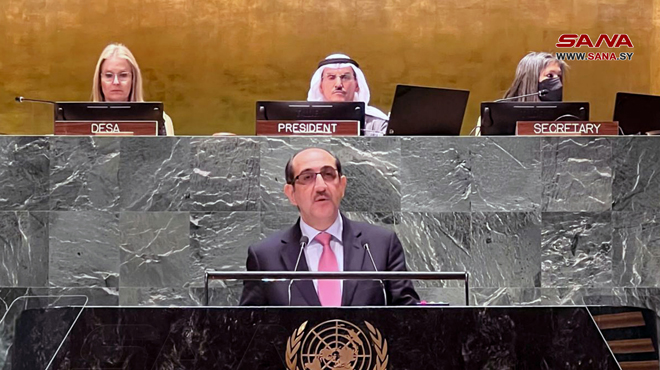
New York (ST): Ambassador Bassam Sabbagh, head of the Syrian delegation to the United Nations Conference (Water for Sustainable Development), confirmed that the terrorist war on Syria has caused enormous damage to the water sector, exceeding $1.2 billion, and that illegal coercive Western measures have hindered the state’s efforts to secure financing for water projects. It placed restrictions on the import of equipment needed to restore damaged facilities, to maintain projects currently operating, or to develop the infrastructure for this vital sector.
In a speech before the United Nations Conference for the Midterm Review of the Implementation of the Goals of the International Decade for Action “Water for Sustainable Development 2018-2028”, Sabbagh expressed Syria’s welcome to hold the conference that puts water at the highest level of interest to shed light on the centrality of water in our daily lives and its direct connection to health, climate, energy and economic development, adding that it indicates the importance of strengthening international cooperation in this field and achieving and accelerating progress towards universal access to safe drinking water and sanitation by 2030.
Sabbagh indicated that the terrorist war caused enormous damage to the water sector in Syria, as terrorist groups used water as a weapon in their war against the Syrian people, as they destroyed, cut off and polluted drinking water sources, destroyed sanitation infrastructure and irrigation projects, and the damage rate of the water sector reached 41 percent. The damage value exceeded $780 million, including water sources, storage, pumping and distribution facilities, and the sewage sector was affected by 60 percent, as the value of damage exceeded $470 million and included the main treatment plants that serve more than 75 percent of the population.
Sabbagh explained that the use of drinking water by terrorist groups as a weapon of war in Hasakeh Governorate during the past years has led to enormous suffering for the people in that region, and that the complete cutting off of drinking water from the Alouk water station for long periods of more than 70 days has led to the deprivation of about a million citizens in the city of Hasakeh and the regions adjacent to it of the only source of drinking water.
Sabbagh pointed out that the devastating earthquake that struck Syria on the sixth of last February caused the destruction of many infrastructure facilities related to the water sector, as more than 80 water tanks, responsible for providing one and a half million people with drinking water in six governorates, were out of service. Many other reservoirs are in dire need of rehabilitation.
Sabbagh stressed that the Syrian state institutions were keen to secure clean water for all its citizens in the darkest conditions, which provided a model for good water management in harsh conditions towards modern irrigation systems that achieve many economic and environmental gains. However, these efforts faced many challenges, most notably the imposition by some Western countries of unilateral coercive measures on Syria that hindered its ability to secure financing for water projects and placed restrictions on importing the necessary equipment to restore damaged facilities or to maintain projects currently working.
K.Q.