
Ambassador Ali Ahmed: Claims of concern for the humanitarian situation in Syria are inconsistent with continuing to exploit it to implement agendas of pressure and political blackmail
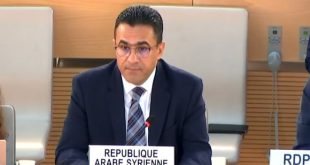
Geneva (ST): The Permanent Representative of Syria to the United Nations Office and other international organizations in Geneva, Ambassador Haider Ali Ahmed, confirmed that the allegations of concern for the human rights and humanitarian conditions in Syria cannot be consistent with the continued blatant exploitation of these noble issues, in implementation of the agendas of pressure and political blackmail, which the Committee represents. The international investigation concerned with Syria is one of its tools, pointing out that the committee’s reports confirm that it is merely a tool of incitement against Syria, and also confirms the correctness of Syria’s position of not recognizing it and its decisions.
Ali Ahmed said in a statement today during the interactive dialogue with the International Commission of Inquiry on Syria within the 54th session of the Human Rights Council in Geneva: In every session of the Council, certain countries impose politicized, selective, and subjective meetings, mechanisms, and reports targeting specific countries, without any actual result or relationship to the protection and promotion of human rights, as is the case today, as it has become known that repeating such meetings and mechanisms is an absurd act and a waste of resources, time and effort.
Ali Ahmed pointed out that this committee still insists since the beginning of the crisis in Syria 12 years ago, on continuing the same biased approach and its subjective reading of the situation in Syria, its causes and consequences.
The Syrian diplomat explained that while the committee has repeatedly involved itself in evaluating issues outside its mandate, it continues to ignore issues that lie at the heart of international human rights law, and have a direct causal relationship with the continued deterioration of the humanitarian and living conditions in Syria, such as the effects of the illegal foreign military presence and terrorism, which continues to be supported by states sponsoring the mandate of the Committee, and the responsibility of the United States for a number of its illegal practices against the Syrian people, and against the unity and territorial integrity of Syria, including acts of aggression, support for separatist groups, and the continuing plunder of natural resources and agricultural crops, which blatantly violate the principle of permanent sovereignty of peoples over their natural resources, not to mention the provocative disregard for its sole responsibility for the catastrophic conditions in camps located in areas of the illegal presence of its forces, including Rukban and Al-Hawl. The irony is that we did not hear a single word of criticism at the Human Rights Council from the committee nor from the countries that claim to be concerned about the humanitarian situation in Syria.
Ali Ahmed stressed that the claims of concern for the human rights and humanitarian conditions in Syria cannot be consistent with the continued blatant exploitation of these noble issues in the implementation of the agendas of pressure and political blackmail, of which this committee is one of its tools. Rather, this concern is achieved through the departure of the American and Turkish military forces from occupied Syrian territories, re-establishing state authority over them, supporting efforts aimed at facilitating the return of displaced persons and refugees to their homes and initiating the immediate and unconditional lifting of the coercive unilateral measures imposed on them.
K.Q.