
All Syrian Sides Will Express Own Vision of Syria’s Future at National Dialogue Congress in Sochi
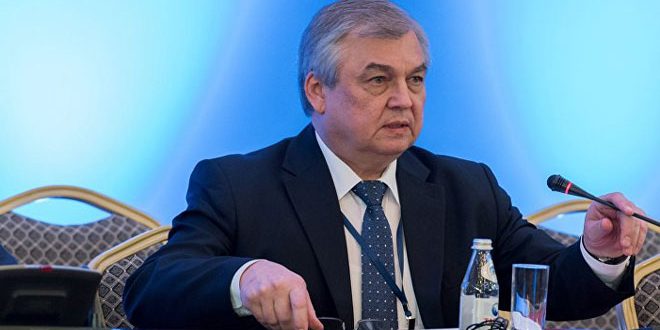
MOSCOW-Russian Special Presidential Envoy Alexander Lavrentyev has called the Astana 8 Meeting on Syria successful, however, noted that episodes of intense fighting in Syria’s de-escalation zones continue.
Interviewed by Sputnik, Lavrentyev said “this round of talks was successful, first of all we have managed to note a progressive development of the situation, the reduction of the level of violence, observation of the ceasefire regime. I should say that quite intense fighting continues in certain areas, but this is mostly provocative in nature and mainly initiated by the so-called implacable armed opposition.”
Bridge to Geneva
Lavrentyev told Sputnik on Friday, after the end of the talks, that de Mistura had been assured in Moscow that the settlement process in Astana was not in conflict with the intra-Syrian talks in Geneva. He added that de Mistura was planning to convene the next Geneva meeting in late January, sometime around January 21.
The Russian special envoy also said that the reconciliation talks in Astana were becoming a good support system for the promotion of the peaceful settlement.
All sides to speak at Syrian National Dialogue Congress
Russia, Iran, and Turkey paid a lot of attention to the Syrian National Dialogue Congress in Sochi, including its participants and timing, during the Astana negotiations, Lavrentyev said Friday.
“We, of course, hope that the special envoy himself will come to Sochi and will participate [in the Congress]. We very much count on this, and we directly talk to him about it. It is clear that the decision will be taken by the UN leadership, but we believe that this Congress should take place under the aegis of the United Nations, and of course this structure should be represented there in the widest possible way, and not only by the members of this organization, which are Russia, Turkey, Iran, Syria and others,” Lavrentyev said.
He went on to say that all the Syrian sides, including the government, internal and external opposition groups, will have the right to express their own vision of Syria’s future at the Congress.
“But the most important thing is that people express their attitude not only to the acting authorities but in general to how they see a further way forward, how they see the organization of truly impartial, fair and transparent elections on their territory… There are many issues,” Lavrentyev added.
Lavrentyev also expressed hope that the Syrian National Dialogue Congress will not be a one-time event and assumed that the work on drafting a new Syrian constitution can continue in Damascus, Geneva or any other place.
“It is necessary to set a clear task and goal and we must strive for it. And then it is a process. We expect that this will not be a one-time event. If it goes under the auspices of the United Nations, under Geneva, this will be absolutely normal and good. This will be precisely the contribution that we make to the issue of the political settlement,” Lavrentyev said.
According to him, the Congress in Sochi should lay the basis for the work on the new constitution.
H.M