
Al-Qudud Al-Halabiya lives in people’s conscience and spreads throughout the world.
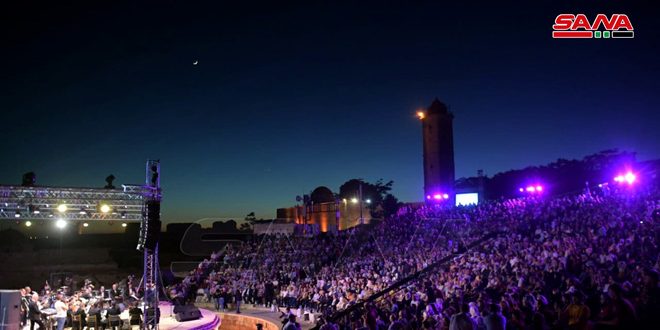
According to many of those who are interested in art, Al-Qudud Al-Halabiya (traditional songs of Aleppo )has been closely associated with the city of Aleppo, has its features, and has made it famous throughout the world. It has proved over the centuries, its ability to continue and has remained deeply rooted in the hearts of people singing it as if it were born today.
It is not surprising that these “Qudud”, with their artistic and cognitive richness, bear the name of the city of Aleppo depicting it as a mecca for men of thought, art and knowledge for hundreds of years. Its people and residents were known for their interest in the different types of music that occupied a large area of their lives; therefore, it well deserved the title of “Capital of Music.”
In a statement to SANA, Maestro Nazih Asaad explained that “Al-Qad” is a traditional melody that was based on religious singing, muwashah, folklore, Aleppine musicians composed tunes and lyrics to suit it, where Al-Qad developed into songs that were widely popular among the people. It differs from the song, which is composed of an introduction, a beginning and an end, as for the Al-Qad, it extends over one tune that is repeated several times according to the singer or musician’s vision.
The art of the Al-Qudud, as Asaad points out, emerged from Sufi circles and worship rituals, as it was sung in religious chants and songs on a particular occasion. It was the beginning of the first seed of “Al-Qad” as it developed within religious circles and takaya. Qudud Halabiya further developed and was popularized by many Aleppine musicians such as Ali Al-Darwish, Jamil Owais, Nadim Darwish, Omar Al-Batsh and Bakri al-Kurdi and others.
Maestro Assad calls for a stronger interest in this musical genre and for it to be circulated in schools and music institutes to raise a generation that knows its heritage well and cares for it. It is an art that holds cultural, artistic, and cognitive importance, as it is close to the people with its social, human, and emotional significance.
Asaad, who leads the Syrian Heritage Band for Music, is very pleased with the achievement of Al-Qudud Al-Halabiya through its registration with the UNESCO Representative List of Human Heritage.
Journalist and music critic Idris Murad pointed out the importance of considering the Al- Qudud as part of the intangible human heritage, as it reflects our eastern heritage and our diverse culture, and affects society, particularly in terms of its ability to carry people’s concerns, and share their joys and sorrows.
Artist Rami Haj Hussein, a Mandolin player, pointed out that the Al- Qudud Al-Halabiya appeared in parallel with the Muwashah, which emerged from Andalusia. It differed from the Qad in that it is composed of three syllables, namely, Al-Mattla’a “the beginning”, Al-Dour, and Al-Qafla, “the end”, each of which has a different rhyme and a short, simple melody, indicating that the Qad appeared as new lyrics with an old melody.
Hussein pointed out that Al-Qudud Al-Halabiya is a type of oriental musical form that has been able to prove its existence in the region and the world because of its eloquence and its closeness to the collective conscience.
Amal Farhat