
Al-Mikdad: Syrian-Iranian relations are strategic
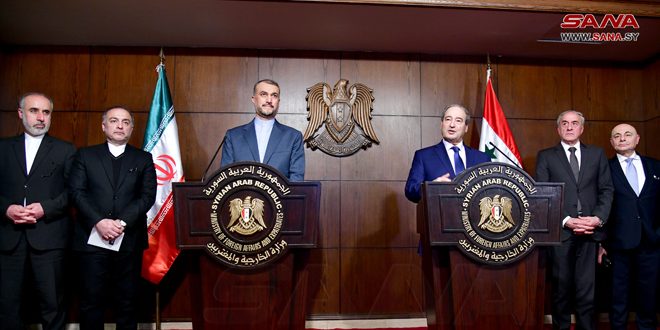
Minister of Foreign Affairs and Expatriates, Dr. Faisal Al-Miqdad, affirmed that the Syrian-Iranian relations are strategic, and that they will be further deepened during the next few days and weeks based on the belief of the two countries in the need to develop them in various fields, in a way that serves the interest of the two countries’ friendly people.
During the press conference held with his Iranian counterpart, Hossein Amir Abdollahian, Al-Mikdad said that this visit comes in light of new developments in the region, as the two countries face constant challenges from Western countries, led by the United States and the Zionist racist entity and the agents of those who they do not want the Syrian people to go through a comfortable period. He asserted that these challenges for Iran have continued since the establishment of the Islamic Revolution in 1979.
Al-Mikdad added, “We extend our thanks to Iran for developing its relations with Syria in various political and economic fields, and we affirm that the relations between our two countries are strategic. In all the meetings held, the two countries discussed the importance of strengthening economic relations between them to confront the illegal Western coercive economic measures imposed on their people.
Al-Mikdad continued: “We meet in order to strengthen bilateral relations and to remove any obstacles facing the public and private sectors in the two brotherly countries with the aim of the development of economic relations. Syria and Iran have great potential in spite of the American occupation forces’ incessant looting for the oil and agricultural wealth of the Syrian people in northeastern Syria.”
“We salute our people in the Syrian Jazira region for their steadfastness in facing the pressures that are being exerted on them like not being allowed to drink clean water,” Al-Mikdad noted. We say to those who prevent water from reaching our people: The end of their policies is near and the situation will not continue as they wish because our people know who their friends are regionally and internationally, and who their enemies are – those who only want them to perish with cholera and other diseases?
In response to a question about the possibility of holding a meeting between the Syrian and Turkish leaderships, Al-Mikdad said: Before 2011, relations between Syria and Turkey were normal and based on good-neighborly policies and concern for the common interests of the two countries. In all our movements since that date until this moment, we strive and exert every possible effort to end terrorism, which disturbed the peace of these relations and stopped them, and led to the destruction of the infrastructure and health and educational institutions in Syria. Therefore, the meeting between Mr. President Bashar Al-Assad and the Turkish leadership depends on removing the reasons that led to this situation and to the differences that replaced the consensus on which the Syrian-Turkish relations were previously built.
In this context, the meeting of the defense ministers of Syria, Russia and Turkey took place in Moscow, where in principle, it discussed some important issues for Syria and Turkey. The practical steps that must be translated into reality were left to a team of technical experts in the armies of the two countries, in the presence and participation of representatives of the Russian armed forces, in order to reach a solution to the problems that have accumulated between the two countries during the last period, including the Turkish military presence on Syrian soil, which we frankly consider as an occupation of our land that must end.”
Al-Mikdad stressed that any political meetings must be built on specific foundations that respect Syria’s sovereignty and territorial integrity and the presence of the armed forces as a real guarantor of the Syrian and neighboring lands. This is what determines the possibility of holding such meetings, because it is not possible to talk about the success of establishing normal relations without ending the occupation and terrorism, and restoring relations to the principles on which they were originally built.
Al-Mikdad expressed Syria’s appreciation for the efforts made by Iran to reform relations between Syria and Turkey, but the Turkish military presence on Syrian soil and the support provided by the Turkish side to some armed organizations hindered these efforts. He pointed out that the existing coordination between Syria and Iran within the framework of Astana and international organizations at various levels in all international forums, proves that Iran always stands with the truth and with the principles it has established in its foreign policy, which is preserving the unity of the land and people of countries, especially Syria.
Al-Mikdad indicated that the repeated Israeli attacks on Syrian lands, including the civilian airports in Damascus, Aleppo and the port of Lattakia, with the support of some international powers, will not remain unanswered .
Al-Mikdad pointed out that the situation on the Palestinian arena was discussed at length, and the position of the two countries in support of the Palestinian people was emphasized. He confirmed the two sides’ condemnation of the Israeli occupation’s attacks and its continuous crimes against the innocent real owners of the land.
In turn, the Iranian Foreign Minister said: “During the meeting with Mr. President Bashar Al-Assad, we shed light on important bilateral issues and strategic, regional and international issues, and Mr. Al-Assad affirmed his invitation to President Ibrahim Raisi to pay a visit to Damascus.” He highlighted the strong relations between Iran and Syria, and that the leaderships of the two countries are determined to expand these relations, especially in the economic and trade fields, in order to reach the level of distinguished political relations.
Abdullahian added: “Our discussions dealt with ways to expand economic and trade relations between our two countries in the private and public sectors, and our views were identical on this issue,” pointing out that cooperation between the two countries continues in all fields, especially in the field of energy, where talks were held at the level of Energy Ministers regarding the establishment of power plants in Syria.
Abdullahian pointed to the signing of several documents between the two countries that are currently being implemented, and the agreement to renew the long-term strategic cooperation document between the two countries for signing in the near future.
With regard to the Syrian-Turkish relations, Abdullahian said: “Syria and Turkey are important countries in the region, and Tehran has distinguished and good relations with both of them. When there were threats of Turkish military aggressions against northern Syria, we worked to prevent that, and we are happy that the diplomatic efforts we made led to dialogue instead of war.” He stressed the necessity of respecting the sovereignty and territorial integrity of countries and Iran’s continuation of its diplomatic efforts for rapprochement and solving the outstanding problems between Syria and Turkey.
Inas Abdulkareem